
The problems faced by procurement teams, in the absence of an eProcurement tool are:
- Difficult to collate requests for purchases across offices via this website hundreds of emails.
- Too much time wasted on answering queries related to purchasing and payments.
- Purchase order creation is time consuming, where even small tasks like fetching the right name and address of the supplier can be time consuming! Hence POs not issued as often as they should be.
- Knowledge on past purchases is close to impossible to dig out from paper files or excels. When a new purchase is to be made selecting the right supplier and getting the best rate is tedious.
- Each branch office goes ahead and does its own purchasing, often not at the best rates, given that there is no centralized platform for coordination across branch offices and the HQ.
- Negotiations with suppliers are often not leveraged to the fullest for best rates, since expected volumes of how much of that product or service will be consumed are not known.
- When suppliers submit invoices to the A/P team or the end users, it is difficult to verify against the paper PO if the invoice is in order. Worse still, if POs are not issued, then invoice reconciliation is even more difficult.
- Large teams are required for procurement to cope with increasing demands from end users, coupled with unrealistic time frames for purchasing.
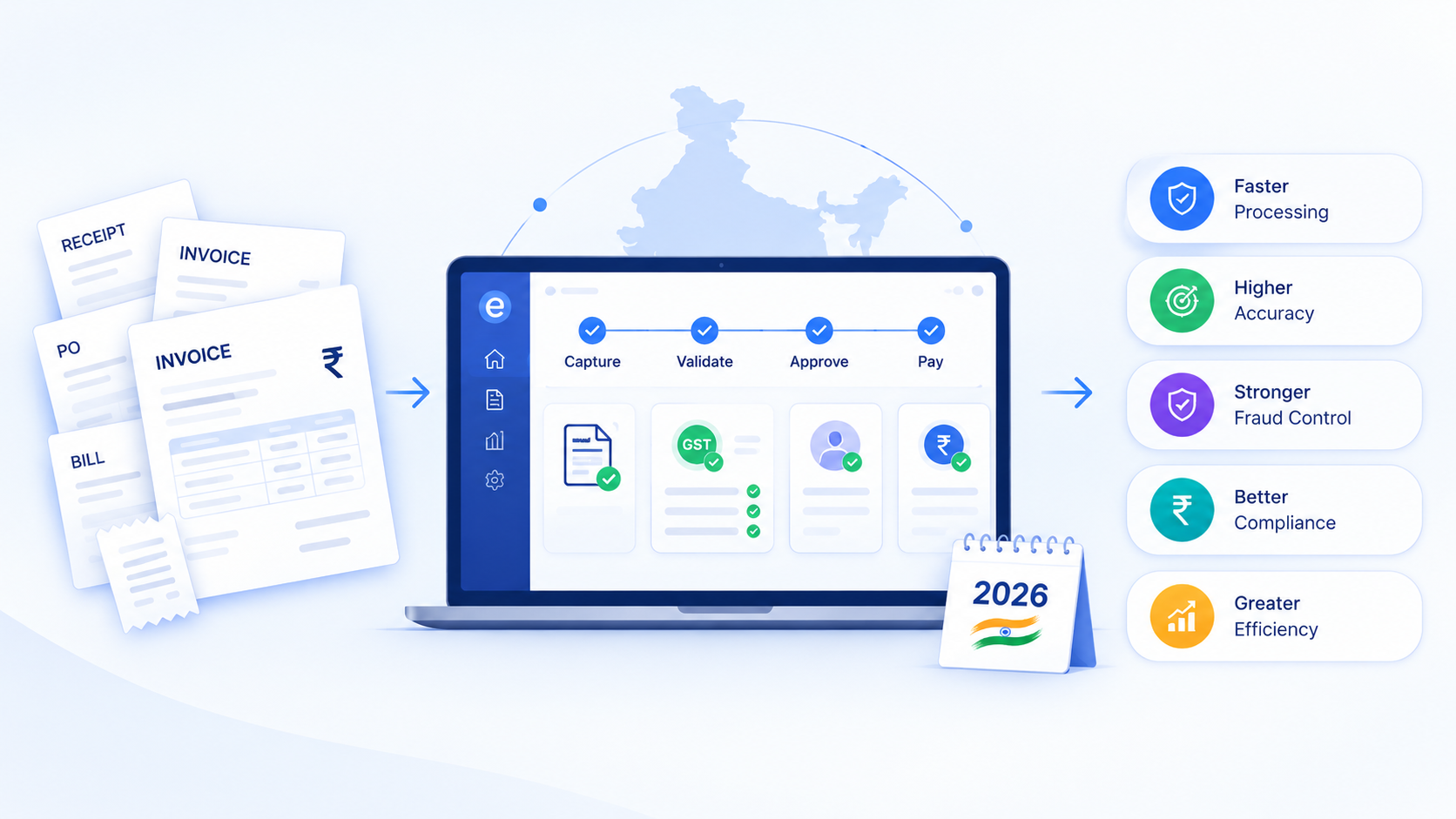
Let’s see what benefits an eProcurement system brings in.
- Procurement is timelier due to efficiencies in every step – requesting, to approving the requests, to searching for past suppliers and so on.
- Lower rates are obtained from suppliers because purchase requests can now be collated for larger volumes, and past spend data can give an idea of how much is the expected demand for this year.
- Tighter process controls for procurement can now be adopted. Right from ensuring that supplier due diligence is done, PO s are placed only where a supplier has been successfully empaneled, more often that not a PO is issued instead of a verbal or a mail communication to the supplier, and the right D of A is enforced.
- Smaller teams can do more, with the efficiencies thatcome in with the software.
- Suppliers appreciate the professional culture in your organisation and try to give you better terms and service.
Procurement has traditionally focused spend management efforts on their firm’s largest suppliers, the vital 20%. These efforts have produced the expected returns but years of cost cutting with large suppliers have squeezed out most of the savings to be gained. Pete Loughlin wrote in Purchasing Insight that ignoring tail spend is potentially leaving huge amounts of money on the table.
A proposition backed by P2P solution providers who estimate that the “huge amounts on the table” could be as high as 5% tail spend savings yielding 10% increase in net profits.
Procurement teams have already started showing measurable savings by addressing tail spend or indirect spend, call it what you will. The agent of change driving cost optimization in the long tail is eProcurement.
In service industries, like the banking and finance industry for example, the indirect spend ratio vis-a-vis total spend is amongst the highest compared to other industries. Procurement teams have been formed in most large organisations to deliver cost savings. In addition to cost savings, companies are looking for tight processes in procurement to reduce risks of malpractices.
The problems faced by procurement teams, in the absence of an eProcurement tool are:
- Difficult to collate requests for purchases across offices via this website hundreds of emails.
- Too much time wasted on answering queries related to purchasing and payments.
- Purchase order creation is time consuming, where even small tasks like fetching the right name and address of the supplier can be time consuming! Hence POs not issued as often as they should be.
- Knowledge on past purchases is close to impossible to dig out from paper files or excels. When a new purchase is to be made selecting the right supplier and getting the best rate is tedious.
- Each branch office goes ahead and does its own purchasing, often not at the best rates, given that there is no centralized platform for coordination across branch offices and the HQ.
- Negotiations with suppliers are often not leveraged to the fullest for best rates, since expected volumes of how much of that product or service will be consumed are not known.
- When suppliers submit invoices to the A/P team or the end users, it is difficult to verify against the paper PO if the invoice is in order. Worse still, if POs are not issued, then invoice reconciliation is even more difficult.
- Large teams are required for procurement to cope with increasing demands from end users, coupled with unrealistic time frames for purchasing.
These are the reasons why many organisations have implemented automated procurement tools using what Gartner calls ‘Postmodern ERPs’. Postmodern ERP is a technology strategy that automates and links administrative and operational business capabilities (such as finance, HR, purchasing, manufacturing and distribution) with appropriate levels of integration that balance the benefits of vendor-delivered integration against business flexibility and agility.
The benefits of eProcurement become obvious in light of the analysis of the problems with manual processes, and looking at the definition of a Postmodern ERP.
Let’s see what benefits an eProcurement system brings in.
- Procurement is timelier due to efficiencies in every step – requesting, to approving the requests, to searching for past suppliers and so on.
- Lower rates are obtained from suppliers because purchase requests can now be collated for larger volumes, and past spend data can give an idea of how much is the expected demand for this year.
- Tighter process controls for procurement can now be adopted. Right from ensuring that supplier due diligence is done, PO s are placed only where a supplier has been successfully empaneled, more often that not a PO is issued instead of a verbal or a mail communication to the supplier, and the right D of A is enforced.
- Smaller teams can do more, with the efficiencies that come in with the software.
- Suppliers appreciate the professional culture in your organisation and try to give you better terms and service.
As the organization starts reaping the benefits of eProcurment and an efficient procurement team, the strategic role of the procurement team gets further cemented in the organization.
Have you automated your procure to pay processes yet? Do you use an online supplier management tool? Have you evaluated eProcurement tools?
Connect with Expenzing to see how Expenzing Procure to Pay Software can transform your procurement team into a strategic asset for your organization.