Blog

How Can AI Detect Invoice Fraud Before Payment?

3 Aug 2026

How Can AI Detect Invoice Fraud Before Payment?

Ila Imani - Founder CEO, Expenzing

The short answer, by scoring an invoice against everything the system already knows about the vendor, the purchase, and the payment details, before that invoice is ever eligible for payment, not by reviewing it after the money has already gone out.


That distinction matters more than it sounds like it should. Once payment has left the account, recovery odds drop fast. Industry data on payments fraud puts recovery of most or all lost funds at roughly 22% of cases, meaning in nearly four out of five incidents, once the money moves, it’s largely gone. That’s the entire argument for catching fraud before payment rather than investigating it afterward, prevention isn’t just cheaper than recovery, it’s usually the only version of this that actually works.

What "before payment" means mechanically

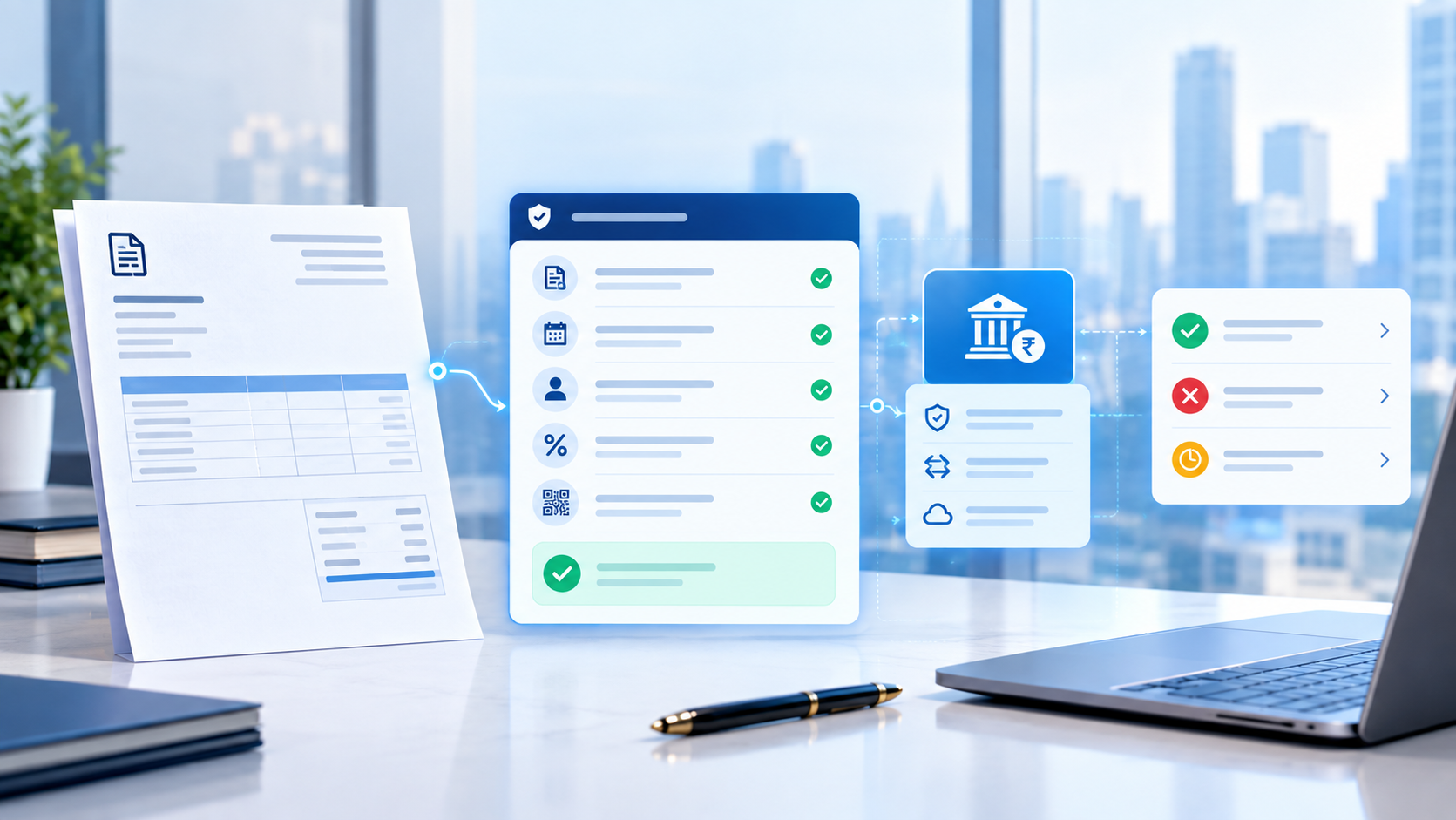
Every invoice that enters an AP system should pass through a sequence of checks before it’s marked eligible for payment, and each one is looking for something different:

  • Vendor legitimacy :  Is the GSTIN valid and currently active? Has this vendor filed their GST returns recently, or has that lapsed? A vendor who’s gone quiet on filings isn’t necessarily fraudulent, but it’s exactly the kind of signal that should surface automatically rather than get missed because nobody thought to check.

  • Payment details against history : Do the bank details on this invoice match what was verified when the vendor was onboarded, or the last time they were confirmed? A bank account that’s changed without independent verification is one of the single strongest fraud indicators there is, and it’s invisible if the system is only reading the invoice for line items and totals.

  • Duplication patterns :  Not just an exact repeat of a prior invoice, but the subtler version, same vendor, same amount, a slightly different invoice number, submitted close together in time.

  • Document consistency :  Does the invoice reconcile against the purchase order and goods receipt, where one exists? Mismatches here aren’t always fraud, but they’re exactly the invoices that should stop for review rather than sail through.

  • Compliance status :  Does this invoice carry a valid e-invoice IRN where required? Is an MSME payment deadline about to lapse? These aren’t fraud checks in the traditional sense, but they’re part of the same idea: catching a problem while there’s still time to act on it.

Why this has to be one score, not a pile of separate flags

Here’s the part that actually determines whether this works in practice, none of those checks mean much in isolation. A GST filing lapse alone might be nothing. A bank detail change alone might be a legitimate update. But a bank detail change on a vendor whose GST filings have also gone quiet, arriving right before an MSME deadline,  that combination is a very different risk profile than any one signal on its own. AI’s real value here isn’t running more checks faster, it’s weighing all of them together into a single judgment: does this invoice go straight to payment, or does it need a person to look at it first.

What this looks like day to day

Most invoices should clear this process without anyone touching them, that’s the point. The ones that don’t clear are the ones actually worth a person’s time, flagged with the specific reason they were stopped, not just a generic “review needed” tag that leaves someone starting the investigation from zero.

That’s the real shift AI makes possible in AP, not fewer checks happening, but every invoice getting the full set of checks, automatically, before payment, which is the only point in the process where catching a problem still means keeping the money.
Read Our Blogs

28 Jul 2026

Why Corporate India Needs Agentic Fraud Detection in 2026 

Ask most AP software vendors whether they do fraud detection, and almost all of them will say yes. Ask what

Ila Imani - Founder CEO, Expenzing

3 Jul 2026

Beyond Basic OCR: The Rise of Touchless Invoice Processing for Multi-State Indian Enterprises

A manufacturer I worked with runs plants in four states. Every one of those plants holds its own GSTIN, because

Shabbir Imani , Founder Director , Expenzing

12 Jun 2026

The Ideal Accounts Payable Automation Framework: An 8-Step Blueprint for Smarter Finance

Accounts Payable has evolved far beyond invoice processing. Today’s finance teams are expected to process invoices faster, maintain complete compliance,

Ila Imani - Founder CEO, Expenzing

See the Possibilities. View our Demo.

satnam

Satnam Kaur

Co-Founder and CTO,
Expenzing

Satnam Kaur, Co-Founder and CTO of Expenzing, is a BITS Pilani alumna with deep expertise in information security, engineering management, and enterprise solution delivery. Beginning her career as a software developer and system analyst, she went on to lead product roadmaps, implementations, and large-scale technology teams. At Expenzing, Satnam heads technology, product development, and Infosec, playing a pivotal role in building secure, enterprise-grade SaaS solutions that balance innovation, precision, and client-centric delivery. A compassionate yet driven leader, she ensures that customer success remains central to every implementation, while also championing process excellence and automation. Beyond work, she enjoys travelling, singing, and contributing to social causes.

shabbir imani

Shabbir Imani

Founder Director,
Expenzing

Shabbir Imani, Co-Founder and Sales Director of Expenzing, holds a PGDM from IIM Calcutta (1985) with a specialization in Finance and Marketing. With over three decades of experience in enterprise solutions, he has a proven track record of scaling software products and driving business growth across industries. At Expenzing, Shabbir leads Sales and Strategy, shaping the company’s go-to-market approach and expanding its reach among large enterprises. A thought leader in spend management and a regular speaker at industry forums, he combines strategic vision with strong execution to deliver measurable business impact for clients, while also nurturing his personal passions for travel, music, and fitness.

illa imani

Ila Imani

Founder CEO,
Expenzing

Ila Imani, Founder CEO, and Product Owner of Expenzing, is an IIM Calcutta alumna (PGDM, 1986) with a specialization in Systems. She began her career as a systems analyst and programmer, gaining first-hand insights into the challenges of fragmented procurement and finance processes. Ila is the visionary behind Expenzing’s Spend Management Suite, guiding its evolution into a leading SaaS platform used by over 100 CFOs and hundreds of thousands of enterprise users. She drives the product roadmap with a strong focus on precision, compliance, and measurable client outcomes. Known for nurturing teams and building lasting client relationships, she drives the product roadmap with a focus on precision, compliance, and measurable outcomes, ensuring Expenzing consistently delivers value while redefining how enterprises control spend and manage compliance.

this for check box

Expenzing: Sourcing, Procurement and Accounts Payable Software
Privacy Overview

This website uses cookies so that we can provide you with the best user experience possible. Cookie information is stored in your browser and performs functions such as recognising you when you return to our website and helping our team to understand which sections of the website you find most interesting and useful.