Most finance teams already know that three-way matching, invoice, purchase order, goods receipt, is the baseline for catching payment errors. What fewer teams realize is how much fraud slips through that baseline anyway. Rate manipulation, advance payments that get billed twice, GST discrepancies that affect input tax credit, none of these show up in a simple three-way check.
This piece breaks down the three technical controls that close those gaps: five-way matching, automated GST validation, and Delegation of Authority workflows.
Key Takeaways
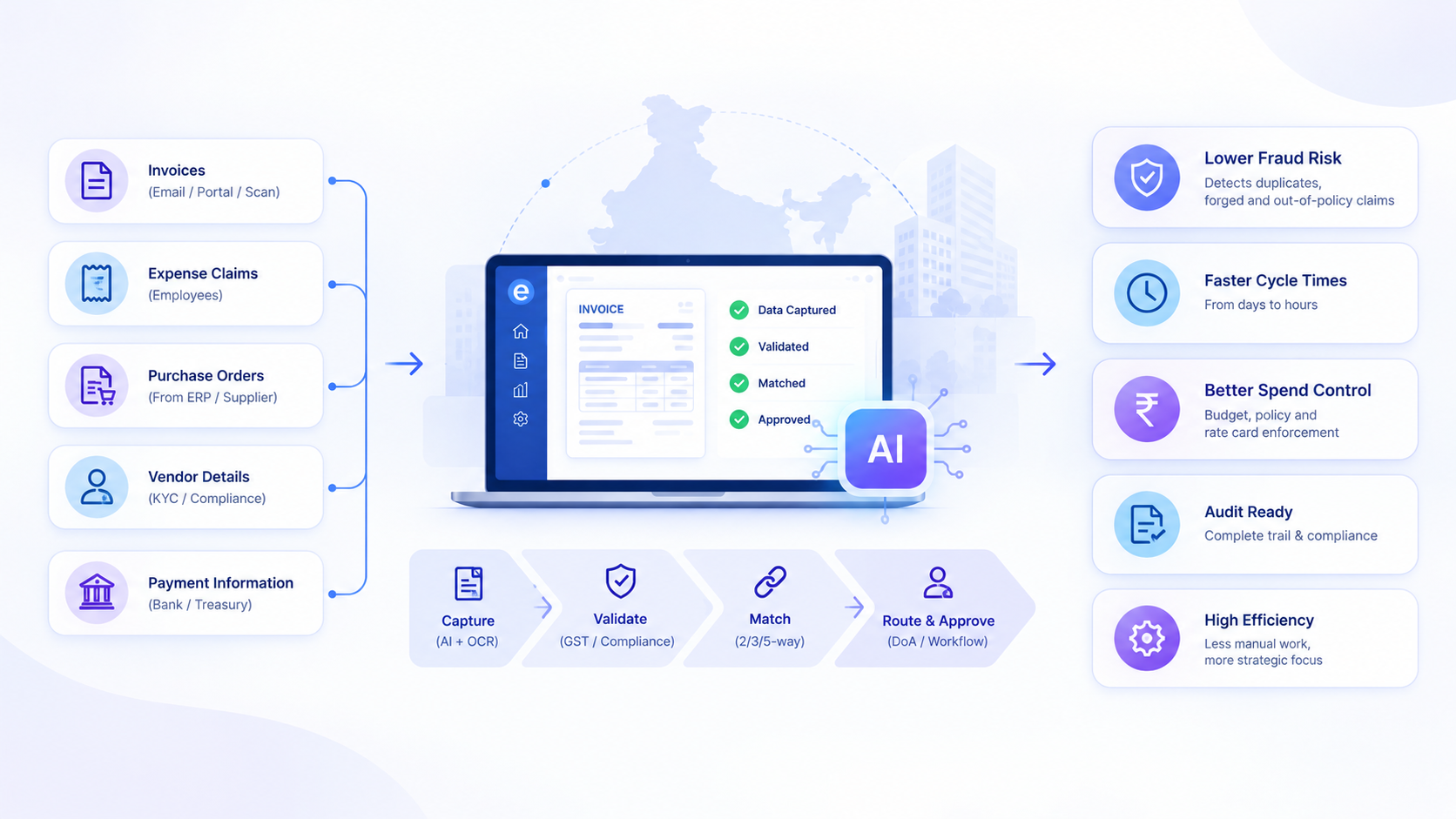
- Expenzing’s five-way matching catches discrepancies across purchase orders, goods receipts, invoices, contracts, and advances paid.
- Automated GSTIN and IRN validation prevents fake invoices from entering your payment queue in the first place.
- Delegation of Authority workflows built into AP automation ensure every payment follows your approval hierarchy without exceptions.
- GST evasion in India has run into several lakh crore over recent years, with a significant share tied to input tax credit fraud, making automated GST validation essential rather than optional.
How Does Five-Way Matching Prevent Payment Errors and Fraud?
Traditional three-way matching catches obvious mismatches, but invoice fraud has gotten more creative than that approach can handle.
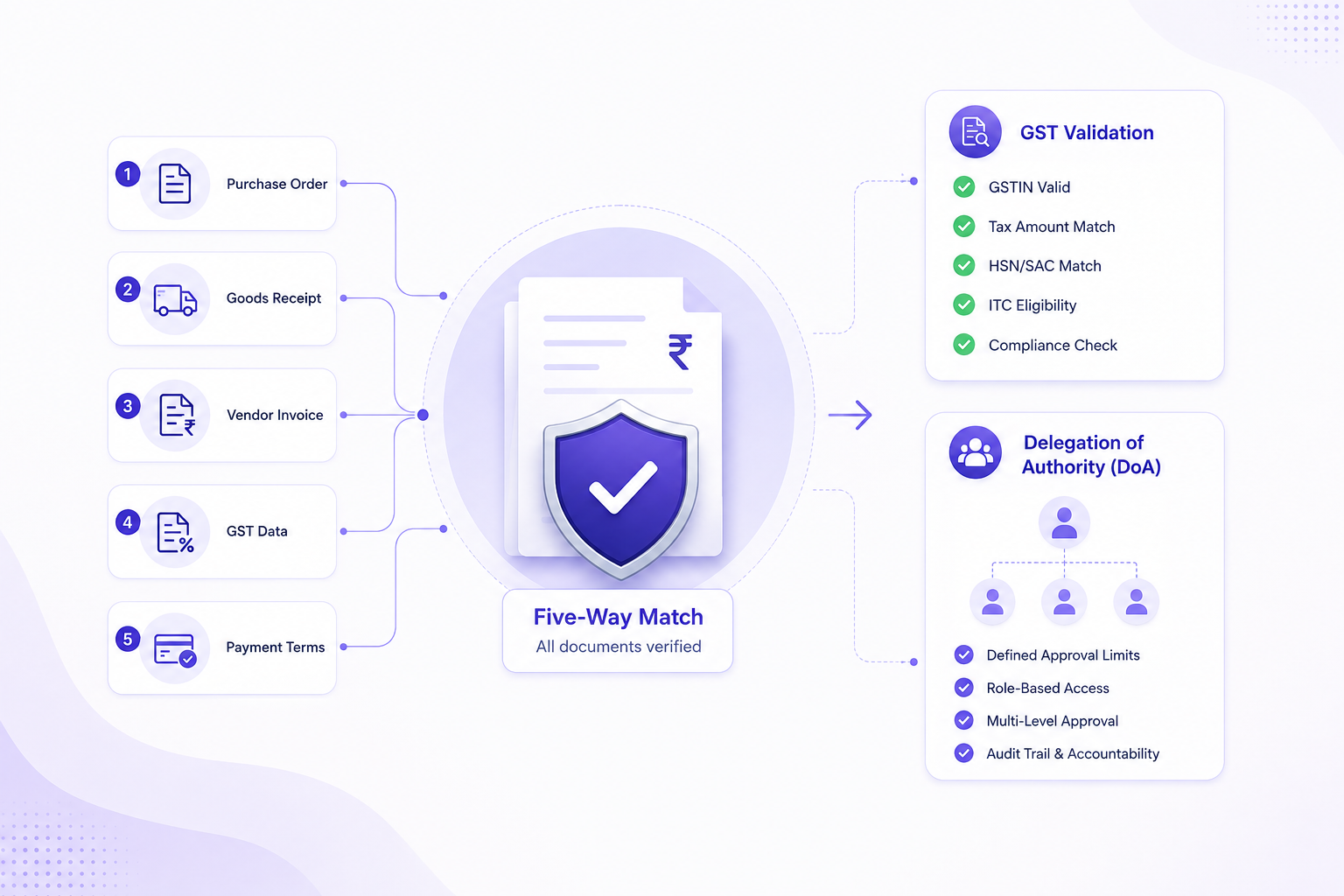
Expenzing’s five-way matching cross-references every invoice against five reference points, Purchase Order (PO), Goods Receipt Note (GRN), Invoice (INV), Vendor Advance, and Contract Rate, catching exactly the scenarios that a three-way check walks right past..
- Quantity verification. Did the invoiced quantity match what the GRN recorded as received? Small overages on individual line items accumulate into significant leakage across hundreds of monthly invoices.
- Rate contract enforcement. Is the invoiced rate consistent with the contracted rate for this vendor and item? Rate manipulation is subtle, often involving rounding that looks like simple variation but systematically favors the vendor.
- Advance payment reconciliation. Has an advance already been paid against this order? Without automatic deduction tracking, vendors sometimes receive both the advance and the full invoice amount.
- Order value limits. Does the total invoice fall within the approved purchase order value? Invoices that exceed PO limits should trigger review, not automatic approval.
- Goods receipt confirmation. Was the GRN created and approved before the invoice was matched against it? A backdated or after-the-fact GRN is a control failure on its own, regardless of whether the quantities happen to line up.
What Role Does GST Validation Play in Fraud Prevention?
For Indian enterprises, GST introduces both fraud risks and detection opportunities. Fake invoices often carry invalid or inactive GSTINs, manipulated tax rates, or missing Invoice Reference Numbers under e-invoicing requirements.
GSTIN status verification. Automated validation checks whether the vendor’s GSTIN is active and whether recent returns have been filed. Vendors with lapsed filings aren’t necessarily running scams, but that signal should surface for review rather than pass unnoticed.
IRN fetching and validation. For invoices that require e-invoicing, automated IRN fetching from the government portal confirms the invoice was actually registered. Fake invoices attempting to claim input tax credit can’t produce valid IRNs.
GST reconciliation. A validated invoice doesn’t mean much if it doesn’t match what’s actually filed. Expenzing continuously reconciles invoice-level tax data against GSTR filings, so mismatches get caught immediately, not when an ITC claim gets rejected or a notice shows up.
According to reporting from The Hindu Business Line, GST evasion exceeded ₹7 lakh crore over five years, with ITC fraud accounting for ₹1.79 lakh crore of detected cases. This scale is exactly why automated GST validation belongs in every AP workflow, not just the ones handling high-value vendors.
How Does Delegation of Authority Protect Against Unauthorized Payments?
Fraud often succeeds by exploiting approval gaps, payments that bypass normal review through exceptions, urgency claims, or simple oversight. Delegation of Authority controls built into AP automation eliminate these vulnerabilities.
Configuring DoA correctly into your spend management system isn’t optional for enterprises serious about fraud prevention, it’s non-negotiable.
- Value-based approval thresholds. Different payment amounts require different approval levels. A ₹10,000 invoice might need only department head approval, while a ₹5,00,000 payment requires finance director sign-off. These thresholds get enforced automatically, not left to manual compliance.
- No exceptions without an audit trail. Manual processes allow quick exceptions, a verbal approval, an email confirmation, a note to process this one differently. Automated systems require every exception to follow a documented path that creates an audit trail for later review.
Where This Fits
Five-way matching, GST validation, and DoA aren’t three separate tools bolted together, they’re layers that catch different failure points in the same payment. Matching catches quantity and rate manipulation. GST validation catches invoices that shouldn’t exist in the first place. DoA catches the human workaround that would otherwise let a flagged invoice through anyway.
The next piece in this series covers the warning signs these controls are designed to catch, and a practical roadmap for rolling them out.
Frequently Asked Questions (FAQs)
What is five-way matching in accounts payable?
Five-way matching compares invoices against purchase orders, goods receipt notes, contracted rates, order value limits, and advance payments already made. This goes beyond traditional three-way matching to catch rate manipulation, quantity inflation, and double-payment scenarios that simpler matching misses.
What GST-specific fraud controls should Indian enterprises implement?
Automated GSTIN validation, IRN fetching for e-invoice verification, tax rate consistency checks, and return filing status monitoring form the essential GST fraud controls. Expenzing validates these elements automatically, preventing fake invoices from entering your payment queue or affecting input tax credit claims.
Can AP automation integrate with existing ERP systems?
Yes. Expenzing AP automation platforms connect with all major ERP systems to share vendor master data, purchase order information, and payment records. Expenzing integrates with accounting systems to maintain a single source of truth while adding fraud detection capabilities that ERPs typically lack.