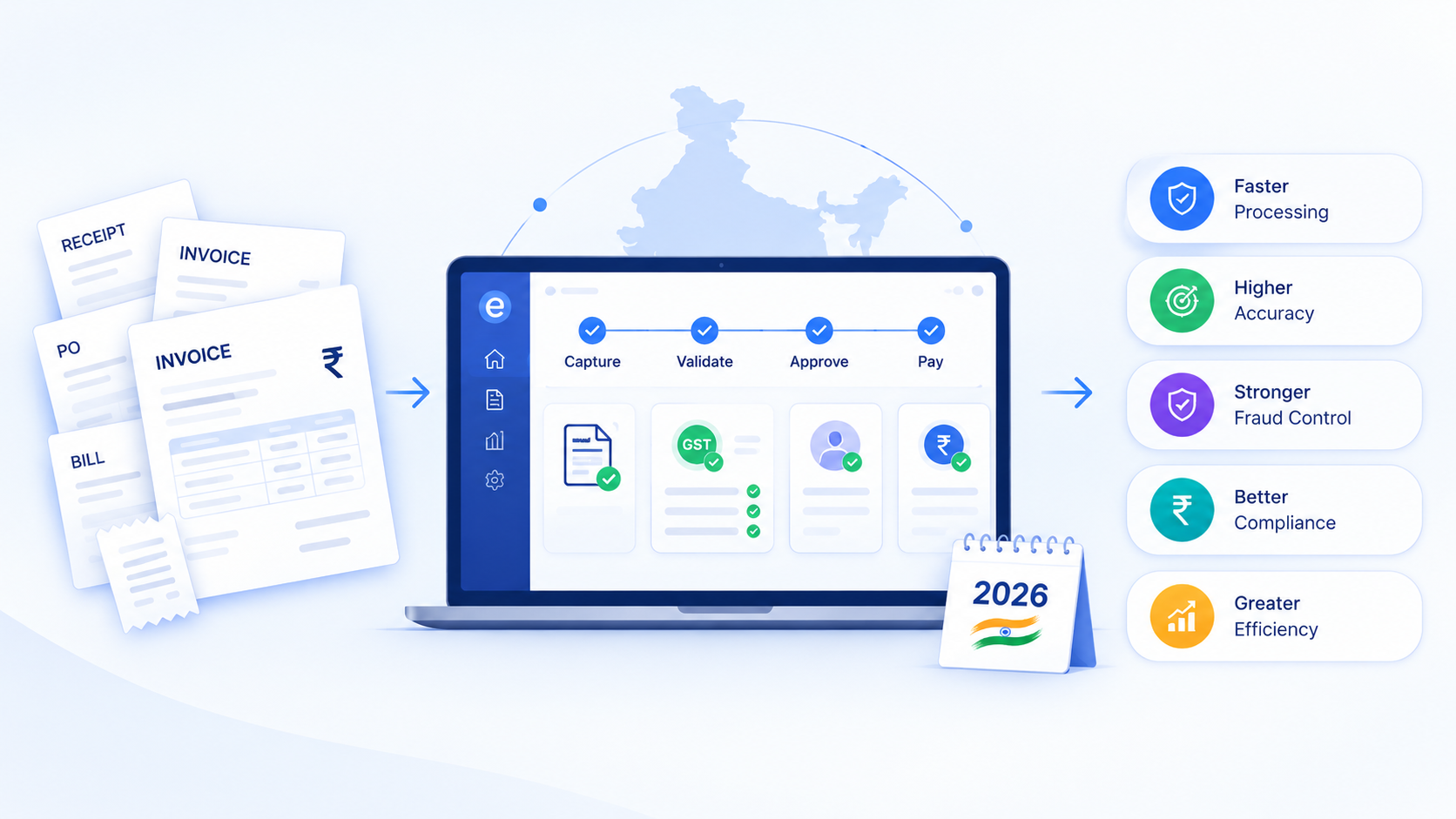

Are you planning a digital transformation journey for procurement and accounts payable?
Is a Supplier Portal for communication and invoicing, on your agenda? Read on.
In an organization’s structure, eProcurement and A/P automation are vital pillars for business operations. The Supplier Portal is a powerful channel which ensures smooth flow of information across these vital pillars.
Here are the critical roles that the Supplier Portal plays in an organization.
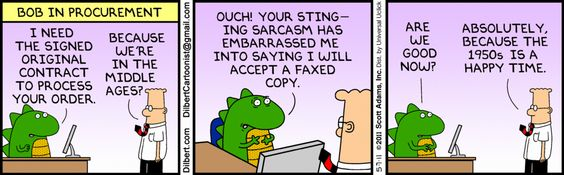
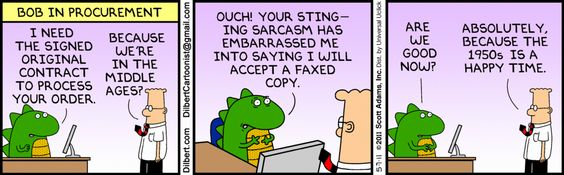 Dilbert: Scott Adams
- Supplier Empanelment: Saves time and effort
- A Dashboard for the Supplier’s transactions: Brings Transparency and Accuracy
- Invoice Inwarding: Reduce Data entry and Processing time
- Query Management: Enhance Auditability
- Natural Integration with e-Procurement and Invoice Management Systems: Reduces Processing time. An end-to-end Procure to Pay Solution like Expenzing offers a naturally integrated supplier portal with the main modules like e-procurement and Invoice Management. This ensures real-time availability of information and overheads of wasted effort. Since a system like Expenzing offers 360-degree visibility for any Purchase Order or Invoice booking, it also brings information from the supplier portal in the purview. Not only does it reduce the processing time, but it also makes the whole function more audit-friendly and easy to track, allowing on-time payments, thereby avoiding any late-fee situation. Some suppliers also offer early payment discounts. Being able to control the invoice processing time helps organizations to negotiate more favorable prices and terms from their suppliers. So, it appears that when it comes to Supplier relations, you can eat your cake and keep it too. Not only does your administrative overload decrease, the resultant transparency, and on-time payments also help to improve relationships with your suppliers.
 For mid-size organizations the administrative overload and manual paperwork for even a small number of suppliers can get overwhelming. For large businesses, the sheer number of suppliers itself is humungous. A digital Supplier Empanelment solution is indeed splendid, where suppliers themselves can fill out their profile information, and upload the required documents. This not only saves the administrative overload and paperwork but also reduces the risk of errors in information being uploaded. Once done, the empanelment process can follow an authorization workflow, after which the supplier is officially onboarded.
 Everyone is talking about data dashboards, and rightly so. A dashboard gives near-complete visibility on a real-time basis.
A supplier who spends significant time in follow-up or clarifying details of purchase orders placed on him by his customer, for example, trying to find out the status of the PO, status of a GRN, status of an invoice, status of approval, etc. can benefit from a dashboard meant for him. This gives him an inclusive experience and provides transparency. It not only saves time at both ends by eliminating the need for constant follow-up but is also vastly reassuring to the supplier.
In addition to the statuses at the customer’s end, a supplier can also view how he has been faring:
How many POs are issued to him?
How many deliveries are complete and for which orders?
How many invoices have been raised, and up to what amount?
This sort of visibility is especially useful for regular suppliers that cater to operational items and services.
Accurate data helps in quicker invoice processing, leading to a vast improvement in the supplier-buyer relationship, resulting in direct/indirect cost benefits.
Everyone is talking about data dashboards, and rightly so. A dashboard gives near-complete visibility on a real-time basis.
A supplier who spends significant time in follow-up or clarifying details of purchase orders placed on him by his customer, for example, trying to find out the status of the PO, status of a GRN, status of an invoice, status of approval, etc. can benefit from a dashboard meant for him. This gives him an inclusive experience and provides transparency. It not only saves time at both ends by eliminating the need for constant follow-up but is also vastly reassuring to the supplier.
In addition to the statuses at the customer’s end, a supplier can also view how he has been faring:
How many POs are issued to him?
How many deliveries are complete and for which orders?
How many invoices have been raised, and up to what amount?
This sort of visibility is especially useful for regular suppliers that cater to operational items and services.
Accurate data helps in quicker invoice processing, leading to a vast improvement in the supplier-buyer relationship, resulting in direct/indirect cost benefits.
 While paperwork related to supplier onboarding is a one-time event in the lifecycle of the supplier, the invoice in-warding is a different challenge altogether. Even mid-size organizations struggle with Invoice inwarding. Many organizations spend huge amounts of their operating capital every month in outsourcing this activity of booking supplier invoices into the system. Using Supplier Portal not only cuts this cost of outsourcing drastically, but also makes the process more inclusive and accurate.
Mature products like the Expenzing Supplier Portal allow suppliers to flip the existing POs into invoice data, thereby reducing their manual data entry effort and ofcourse, errors. The ‘flipping of PO’ functionality also ensures that the rates, quantities, and item descriptions on the invoice match the issued PO.
While paperwork related to supplier onboarding is a one-time event in the lifecycle of the supplier, the invoice in-warding is a different challenge altogether. Even mid-size organizations struggle with Invoice inwarding. Many organizations spend huge amounts of their operating capital every month in outsourcing this activity of booking supplier invoices into the system. Using Supplier Portal not only cuts this cost of outsourcing drastically, but also makes the process more inclusive and accurate.
Mature products like the Expenzing Supplier Portal allow suppliers to flip the existing POs into invoice data, thereby reducing their manual data entry effort and ofcourse, errors. The ‘flipping of PO’ functionality also ensures that the rates, quantities, and item descriptions on the invoice match the issued PO.
 The typical queries a supplier would have are:
Have you received my items?
Have you received my invoice?
When are you going to pay me?
Since all these queries are automatically answered by using a full-featured supplier portal, the A/P team can save time of answering queries and also process invoices faster.
In the absence of a Portal, suppliers who are third-party stakeholders, rely on mails and phone calls for even important communication, causing an auditability nightmare. Using a supplier portal for this sort of query handling will not only ensure that the communication does not disappear into people’s mail inboxes but is also attached to the right PO and Invoice.
Dilbert: Scott Adams
The typical queries a supplier would have are:
Have you received my items?
Have you received my invoice?
When are you going to pay me?
Since all these queries are automatically answered by using a full-featured supplier portal, the A/P team can save time of answering queries and also process invoices faster.
In the absence of a Portal, suppliers who are third-party stakeholders, rely on mails and phone calls for even important communication, causing an auditability nightmare. Using a supplier portal for this sort of query handling will not only ensure that the communication does not disappear into people’s mail inboxes but is also attached to the right PO and Invoice.
Dilbert: Scott Adams