
Blog

A Nation Obsessed With Paper

8 Feb 2015

A Nation Obsessed With Paper

Ila Imani - Founder CEO, Expenzing

blog 57 header
On a recent visit to Colombo I travelled by public bus and paid the conductor for my ticket but did not get one. I was thinking about the great public transport scam that I was now a party to before I realised that no paper tickets were being issued. The transport corporation had done away with the little stubby tickets and rely on the conductor to control ticketless travel.
As a result Colombo bus stops are not littered with discarded ticket stubs. The conductor’s passenger processing time has become shorter and the number of tasks he needs to do has reduced. Clearly efficiency and cleanliness have been the winners.A mere 60 minute flight away in Bangalore, the Indian obsession with paper tells a different story. I returned to find snail mail from my bank – a two page covering letter on separate sheets of paper asking for a Know Your Customer (KYC) update accompanied by the KYC form stuffed in an envelope. Today I’ll have to manually fill the form, stick photographs, xerox my passport (front and back) and attach it to the form, then trudge to the bank, wait in a queue, submit it and possibly get a paper receipt as confirmation.India has an obsession with paper. Don’t get me wrong. I do appreciate the qualitative difference in reading a bound book than one on my Kindle. But if I need a recipe in the kitchen I’ll just watch a YouTube video on how to cook the dish on my smartphone or even read the recipe off the screen. My grouse is against the humungous amount of time wasted in moving paper to move information, in the time spent searching for documents, the difficulty of deciphering handwritten comments on paper, the challenge of lost documents …. I could go on. Paper was a breakthrough from the engraved stone tablet but information technology and automation are to paper what paper was to stone tablets.Our firm develops software that uses information technology to automate and streamline many basic business management processes such as expense management, travel planning and execution, and procurement. Expense management is a perfect example of a business process that takes up time and causes tempers to rise mainly because of the role of paper in the old system of expense management.Look at a typical expense management event. Kavita, a sales manager at a midsized company has a lunch meeting with a client. She takes a taxi from office to the restaurant and back, picks up the restaurant tab, and pays a tip to the waiter. She has to collect the restaurant receipt, make a mental or physical note of the taxi fare paid and keep the supporting in a safe place so that she can sit down end of week and do her vouchers for the week. Yes, Kavita is a busy manager and this paperwork is a chore. The voucher submission is another form that she has to fill up, often multiple forms so that costs can be booked to specific clients or account heads. And after she submits her vouchers, they are checked for arithmetic accuracy, then an office boy takes the file to the approver who is also a road warrior and likely to be OOO. The saga goes on and on.Now take a look at the paper-light or streamlined way of travel expense management.

paper

The ease of data capture, speed at which information moves from one node to the next, ability to collate and batch process, and ease of approving, accounting, and reimbursing are a delight to all parties along the expense management chain. They are all happier because they spend less time doing what is currently seen as painful tasks and the company benefits from the time saved in everyone’s workday.The value of the delight from this enhanced experience is as much emotional as it is rational. It reminds me of the wow I experienced at an Apple store in the Seattle. A store assistant helped me with my queries at the rack with Apple TVs. I said okay I think I’ll buy one and then magic happened. The assistant pulled out a hand held device swiped my credit card which was recognised from an earlier purchase made in India so my billing address and details were already captured with no requirement for data entry. I walked out of the store within seconds with my product in hand and heard a ping as my Blackberry got an email with the invoice as a pdf.

On a recent visit to Colombo I travelled by public bus and paid the conductor for my ticket but did not get one. I was thinking about the great public transport scam that I was now a party to before I realised that no paper tickets were being issued. The transport corporation had done away with the little stubby tickets and rely on the conductor to control ticketless travel.

As a result Colombo bus stops are not littered with discarded ticket stubs. The conductor’s passenger processing time has become shorter and the number of tasks he needs to do has reduced. Clearly efficiency and cleanliness have been the winners. A mere 60 minute flight away in Bangalore, the Indian obsession with paper tells a different story. I returned to find snail mail from my bank – a two page covering letter on separate sheets of paper asking for a Know Your Customer (KYC) update accompanied by the KYC form stuffed in an envelope. Today I’ll have to manually fill the form, stick photographs, xerox my passport (front and back) and attach it to the form, then trudge to the bank, wait in a queue, submit it and possibly get a paper receipt as confirmation.India has an obsession with paper. Don’t get me wrong. I do appreciate the qualitative difference in reading a bound book than one on my Kindle. But if I need a recipe in the kitchen I’ll just watch a YouTube video on how to cook the dish on my smartphone or even read the recipe off the screen. My grouse is against the humungous amount of time wasted in moving paper to move information, in the time spent searching for documents, the difficulty of deciphering handwritten comments on paper, the challenge of lost documents …. I could go on. Paper was a breakthrough from the engraved stone tablet but information technology and automation are to paper what paper was to stone tablets.

Our firm develops software that uses information technology to automate and streamline many basic business management processes such as expense management, travel planning and execution, and procurement. Expense management is a perfect example of a business process that takes up time and causes tempers to rise mainly because of the role of paper in the old system of expense management.

Look at a typical expense management event. Kavita, a sales manager at a midsized company has a lunch meeting with a client. She takes a taxi from office to the restaurant and back, picks up the restaurant tab, and pays a tip to the waiter. She has to collect the restaurant receipt, make a mental or physical note of the taxi fare paid and keep the supporting in a safe place so that she can sit down end of week and do her vouchers for the week. Yes, Kavita is a busy manager and this paperwork is a chore. The voucher submission is another form that she has to fill up, often multiple forms so that costs can be booked to specific clients or account heads. And after she submits her vouchers, they are checked for arithmetic accuracy, then an office boy takes the file to the approver who is also a road warrior and likely to be OOO. The saga goes on and on.

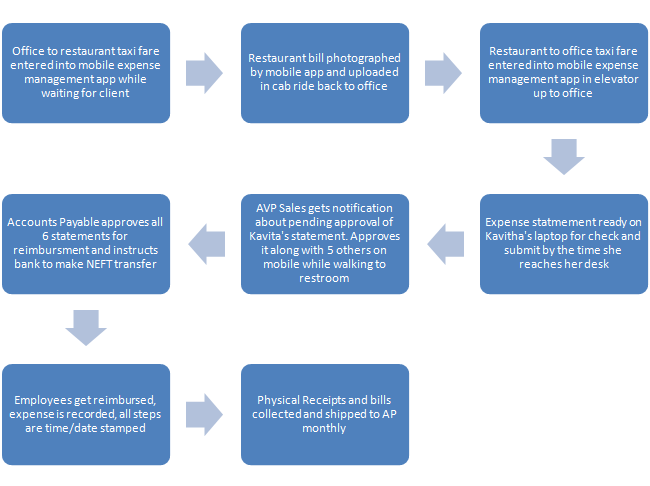
Now take a look at the paper-light or streamlined way of travel expense management.
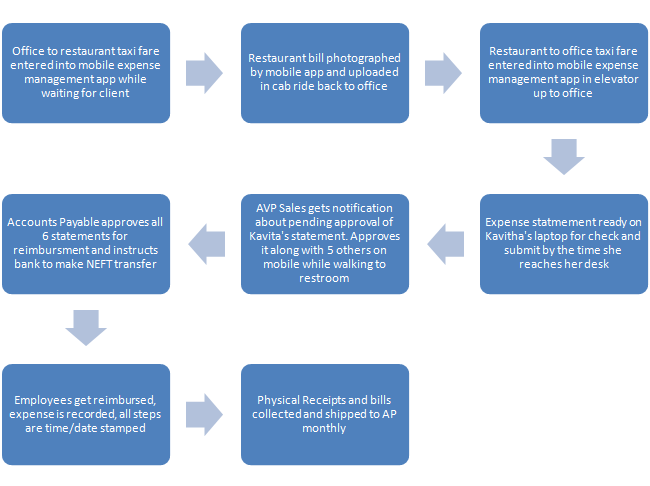
blog 57 img1

The ease of data capture, speed at which information moves from one node to the next, ability to collate and batch process, and ease of approving, accounting, and reimbursing are a delight to all parties along the expense management chain. They are all happier because they spend less time doing what is currently seen as painful tasks and the company benefits from the time saved in everyone’s workday.

The value of the delight from this enhanced experience is as much emotional as it is rational. It reminds me of the wow I experienced at an Apple store in the Seattle. A store assistant helped me with my queries at the rack with Apple TVs. I said okay I think I’ll buy one and then magic happened. The assistant pulled out a hand held device swiped my credit card which was recognised from an earlier purchase made in India so my billing address and details were already captured with no requirement for data entry. I walked out of the store within seconds with my product in hand and heard a ping as my Blackberry got an email with the invoice as a pdf.

Read Our Blogs

blog expenzing

27 Nov 2025

Expenzing Infosecurity: The Backbone of Trust in EnterpriseSaaS Spend Management

In an era where data breaches and cyber threats dominate headlines and regulatory landscapes evolve rapidly, information security (infosec) stands

Satnam Kaur - Co-Founder and CTO, Expenzing

blog_feature_image

11 Nov 2025

The Fudge Factor in Indian business

I’ve been around enough Indian boardrooms, travel desks, and vendor meetings to see a pattern: it’s rarely the big heists

Ila Imani - Founder CEO, Expenzing

blog

21 Aug 2025

Why Organisations Are Automating Contract Management

Vendor contract management is no longer just paperwork,it’s a compliance and risk management necessity. As regulations tighten and vendor ecosystems

Dipti Mhatre

See the Possibilities. View our Demo.

satnam

Satnam Kaur

Co-Founder and CTO,
Expenzing

Satnam Kaur, Co-Founder and CTO of Expenzing, is a BITS Pilani alumna with deep expertise in information security, engineering management, and enterprise solution delivery. Beginning her career as a software developer and system analyst, she went on to lead product roadmaps, implementations, and large-scale technology teams. At Expenzing, Satnam heads technology, product development, and Infosec, playing a pivotal role in building secure, enterprise-grade SaaS solutions that balance innovation, precision, and client-centric delivery. A compassionate yet driven leader, she ensures that customer success remains central to every implementation, while also championing process excellence and automation. Beyond work, she enjoys travelling, singing, and contributing to social causes.

shabbir imani

Shabbir Imani

Founder Director,
Expenzing

Shabbir Imani, Co-Founder and Sales Director of Expenzing, holds a PGDM from IIM Calcutta (1985) with a specialization in Finance and Marketing. With over three decades of experience in enterprise solutions, he has a proven track record of scaling software products and driving business growth across industries. At Expenzing, Shabbir leads Sales and Strategy, shaping the company’s go-to-market approach and expanding its reach among large enterprises. A thought leader in spend management and a regular speaker at industry forums, he combines strategic vision with strong execution to deliver measurable business impact for clients, while also nurturing his personal passions for travel, music, and fitness.

illa imani

Ila Imani

Founder CEO,
Expenzing

Ila Imani, Founder CEO, and Product Owner of Expenzing, is an IIM Calcutta alumna (PGDM, 1986) with a specialization in Systems. She began her career as a systems analyst and programmer, gaining first-hand insights into the challenges of fragmented procurement and finance processes. Ila is the visionary behind Expenzing’s Spend Management Suite, guiding its evolution into a leading SaaS platform used by over 100 CFOs and hundreds of thousands of enterprise users. She drives the product roadmap with a strong focus on precision, compliance, and measurable client outcomes. Known for nurturing teams and building lasting client relationships, she drives the product roadmap with a focus on precision, compliance, and measurable outcomes, ensuring Expenzing consistently delivers value while redefining how enterprises control spend and manage compliance.

this for check box

Expenzing: Sourcing, Procurement and Accounts Payable Software
Privacy Overview

This website uses cookies so that we can provide you with the best user experience possible. Cookie information is stored in your browser and performs functions such as recognising you when you return to our website and helping our team to understand which sections of the website you find most interesting and useful.