For NBFCs, travel and expense spend is never just a cost line. Field-heavy teams, branch networks, collections staff and audit-ready reporting mean every trip, claim and reimbursement can become a fraud, compliance or governance question. Choosing among the many travel expense management platforms available in India in 2026 comes down to four things: fraud controls, approval governance, compliance readiness and how usable the tool is for finance teams.
Key takeaways
- The best travel expense management platforms for NBFCs combine booking, policy enforcement, claims and reconciliation in one workflow, not four disconnected tools.
- Fraud controls such as duplicate detection, receipt validation and policy-linked flags matter more than cosmetic features like mobile design.
- Approval governance should support multi-level, role-based and branch-wise workflows with a complete audit trail.
- Compliance readiness means GST-aware capture, TDS handling, audit logs and clean integration with your ERP or core finance systems.
- Finance team usability decides adoption: if claims take longer to review than before, the platform will not stick.
- Shortlist two or three platforms, run a pilot on real branch and field data, and score each against the same criteria.
Why NBFCs need a different approach to travel expense management
NBFCs operate differently from a typical corporate. Sales, credit, collections and risk teams travel constantly across branches, often with small, frequent claims that are hard to verify one by one. At the same time, NBFCs are regulated entities where internal controls, audit trails and spend discipline are scrutinised closely.
That creates three recurring problems:
- Volume without visibility. Thousands of small claims from field staff make manual review slow and patchy.
- Policy drift. Grade-wise limits and city-tier rules are hard to enforce in spreadsheets and email approvals.
- Audit pressure. Finance teams must be able to show who approved what, when, and against which policy.
Generic expense reporting software can handle basic claims. NBFC expense management needs more: controls built for scale and scrutiny.
How we compared the platforms
This comparison uses four criteria, weighted for NBFC realities rather than generic corporate needs.
1. Fraud controls
Look for duplicate-claim detection across employees and dates, receipt and invoice validation, mileage and location sanity checks, and automatic flags when a claim breaches policy. The question to ask any vendor: does the system prevent bad claims, or only report them after payout?
2. Approval governance
Check whether approval chains can follow your org structure (branch, region, function), handle delegation when approvers are away, and keep an immutable record of every decision. Pre-trip approvals tied to budgets are a strong signal of mature governance.
3. Compliance readiness
For financial services travel management, this includes GST-compliant invoice capture, TDS treatment where applicable, audit logs, role-based access and data residency. Integration with your accounting or ERP system should be proven, not promised.
4. Finance team usability
Measure how quickly a finance executive can review, query and close a claim. Dashboards, exception queues, bulk actions and clear reports matter as much as the employee-facing app.
Platform comparison at a glance
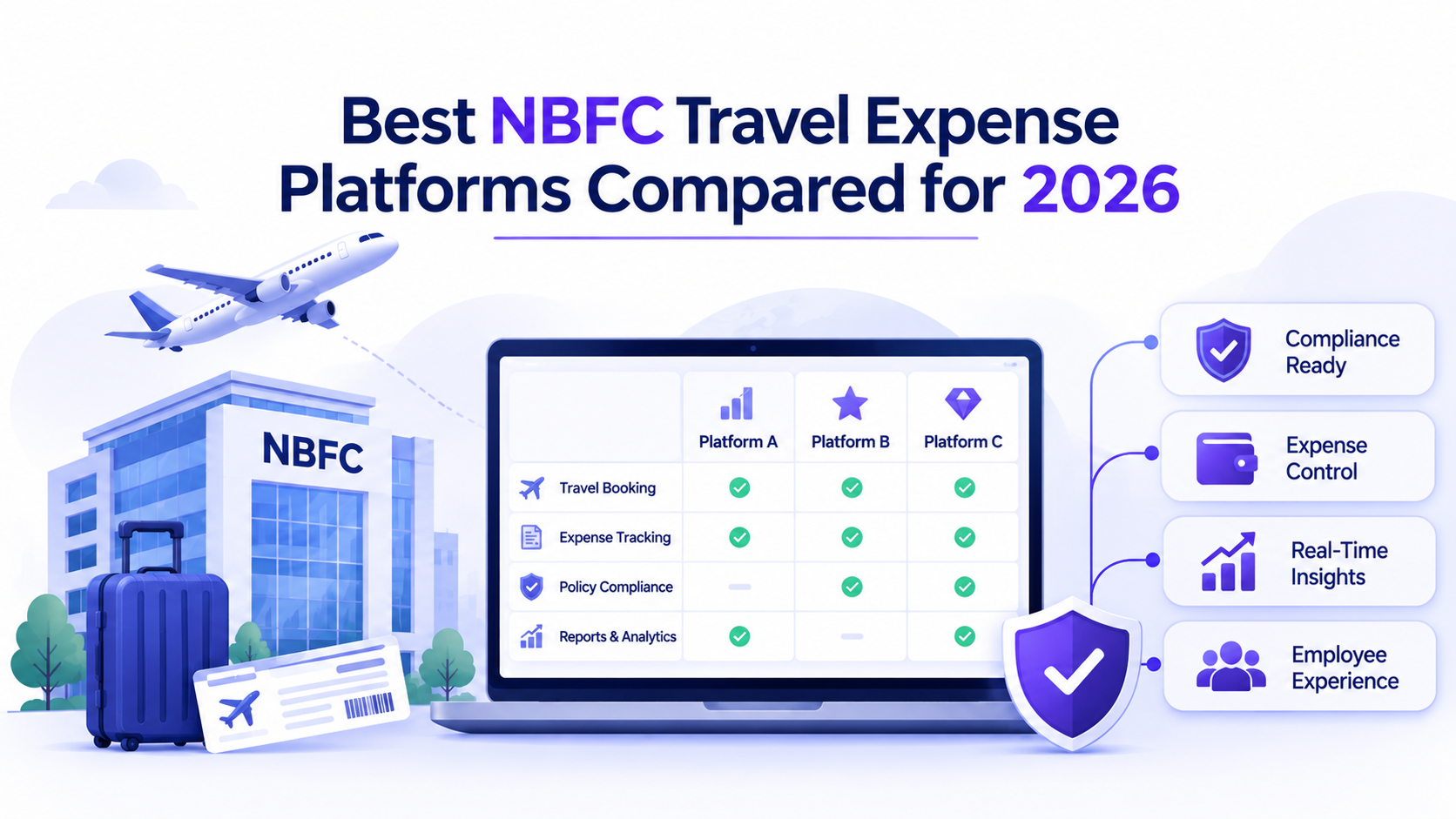
The table below summarises how leading categories of platforms typically perform against the four criteria. Capabilities vary by plan and configuration, so verify details with each vendor during your evaluation.
|
Platform type |
Fraud controls |
Approval governance |
Compliance readiness |
Finance usability |
Best fit |
|
Spend management platforms built for Indian enterprises (such as Expenzing) |
Policy-linked flags, automated checks and exception handling |
Multi-level, role-based workflows with audit trail |
Built around Indian tax and audit requirements |
Designed for finance review at scale |
NBFCs and BFSI firms with large field teams |
|
Global enterprise T&E suites |
Strong, often highly configurable |
Deep, but can need heavy setup |
Strong globally, India localisation varies |
Powerful but can be complex |
Large multinational groups |
|
Indian expense and card-led platforms |
Varies by product |
Good for standard workflows |
Generally India-aware |
Usually quick to adopt |
Mid-sized firms wanting fast rollout |
|
Travel booking tools with basic expense modules |
Limited |
Basic approvals |
Limited reconciliation depth |
Simple, but shallow reporting |
Small teams with simple policies |
|
Spreadsheets and email approvals |
None built in |
Manual |
Weak audit trail |
High effort at scale |
Not recommended for NBFCs |
Platform categories in detail
Spend management platforms built for Indian enterprises
Platforms such as Expenzing are designed around the realities of Indian BFSI and NBFC finance teams: high claim volumes, grade-wise policies, GST and TDS considerations, and audit expectations. Their advantage is fit. Policy rules, approval chains and reconciliation are configured around how Indian enterprises actually operate, and the platform extends beyond travel into broader spend management and AP automation, which reduces tool sprawl.
Consider this option if: your finance team wants one system for corporate travel expenses, reimbursements and spend controls, with India-specific compliance built in.
Global enterprise T&E suites
These are mature, feature-rich platforms with deep configuration. They suit multinational groups with complex cross-border travel. For a domestic NBFC, the trade-offs are often cost, implementation time and the effort needed to localise for Indian tax and reimbursement norms.
Consider this option if: you operate across multiple countries and already run a global finance stack.
Indian expense and card-led platforms
Many Indian platforms combine expense reporting software with corporate cards or prepaid instruments. Adoption tends to be fast and the employee experience is polished. Evaluate carefully how deep the approval governance and audit reporting go, since NBFC needs often exceed what lighter tools offer.
Consider this option if: speed of rollout matters most and your policies are relatively standard.
Travel booking tools with expense add-ons
Business travel management tools are strong at booking and itinerary control. Their expense modules are often secondary, which can leave gaps in claim validation and reconciliation.
Consider this option if: booking control is your main pain point and claims volume is modest.
How to choose: a simple scoring approach
- List your non-negotiables. For most NBFCs these are fraud controls, audit trail and ERP integration.
- Weight the four criteria. A common split is fraud controls 30%, approval governance 25%, compliance readiness 25% and finance usability 20%.
- Pilot with real data. Run one branch or region for 30 days and compare review time, exceptions caught and approval turnaround.
- Involve finance reviewers early. The people who close claims every month will spot usability gaps faster than any demo.
- Check total cost, not licence price. Include implementation, integration and training effort.
Conclusion
The right travel expense management platform for an NBFC is the one that stops problems before payout, gives finance leaders clean governance and stands up to audit, without slowing down the team that reviews claims every day. Score vendors against fraud controls, approval governance, compliance readiness and finance usability, pilot on real data, and choose the platform your finance team will actually use.
Ready to see how this works in practice? Book a demo with Expenzing to explore how NBFC finance teams control travel and expense spend.
Frequently Asked Questions (FAQs)
What are travel expense management platforms?
Travel expense management platforms are software tools that manage business trips and employee spend end to end, covering booking, pre-trip approvals, expense capture, policy checks, reimbursement and reporting.
Why do NBFCs need specialised expense management?
NBFCs have large field workforces, high claim volumes and strict audit expectations. Specialised NBFC expense management adds fraud controls, multi-level governance and compliance features that generic tools may lack.
What features matter most in expense reporting software for financial services?
Duplicate detection, receipt validation, policy-linked approvals, audit logs, GST-aware capture, ERP integration and an efficient finance review workflow.
Should NBFCs choose a global suite or an India-focused platform?
It depends on scope. Domestic NBFCs usually benefit from India-focused platforms because tax, reimbursement and audit requirements are built in. Groups with significant international travel may need a global suite.