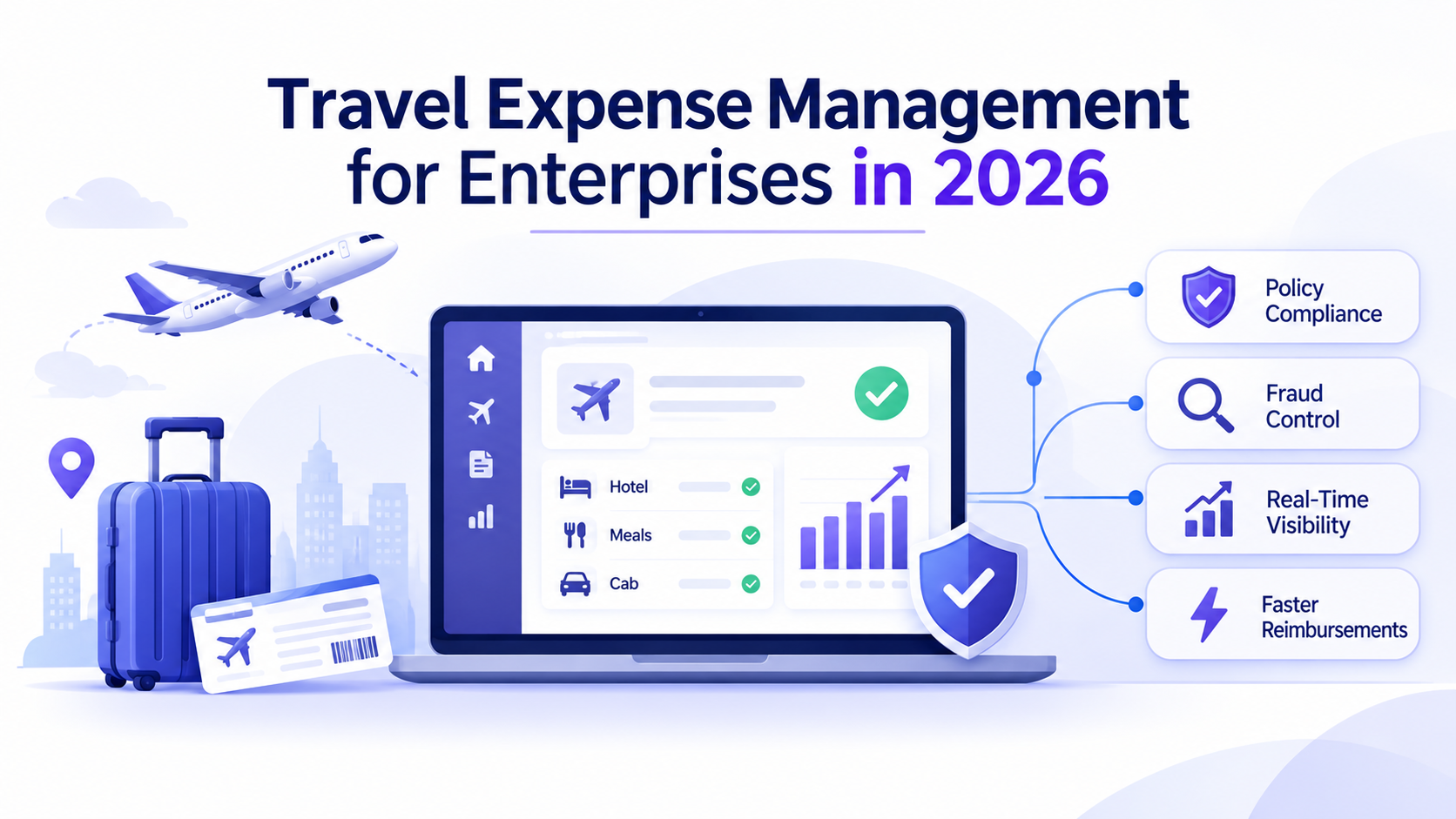

An NBFC’s travel bill rarely looks like a corporate’s. It isn’t a few executives flying business class. It is hundreds or thousands of field officers, collection and sales teams, credit and verification staff, and branch managers, making short trips and local conveyance claims every day. This guide explains how to evaluate travel expense management platforms for that reality, and what an audit-ready set-up looks like.
Key takeaways
- The best travel expense management platform for an NBFC is the one that handles high-volume, low-value field claims with policy control, not just the one with a polished booking tool.
- Five criteria should drive your shortlist: policy control, audit trail, reimbursement workflow, tax and compliance capture, and security and data handling.
- NBFC travel is branch-led and field-heavy, so look for mileage and local conveyance support, per diems by grade and location, and mobile-first claims.
- Audit trail quality matters more than reporting polish. You should be able to show who approved a claim, under which rule, and when.
- Reimbursement should connect to your payroll or payout process, so approved claims don’t wait for manual handoffs.
- Ask for the vendor’s data location, access controls and outsourcing arrangements early. Your compliance and information security teams will.
- Pilot on real claims from two or three branches before you commit.
What are travel expense management platforms?
Travel expense management platforms are software systems that manage how employees plan and book business travel, record spend, submit expense claims and receive reimbursement, while applying company policy and keeping a record of every approval.
Several related terms get used loosely. Business travel management usually refers to booking and supplier management. Expense reporting is the claim and approval side. Expense tracking software often means mobile capture and categorisation of spend. A complete platform joins these, so the trip request, the booking, the claim and the payout sit in one record.
Why do NBFCs need a different approach to expense management?
Three features of NBFC operations change the requirements.
- Distributed workforce. Field teams work from branches, not a head office. Claims come from many locations, often with small amounts and varied supporting documents.
- Layered authority. Approvals follow reporting lines, regional structures and thresholds. A branch-level claim and a head-office trip should not follow the same route.
- Scrutiny. NBFCs face internal audit, statutory audit, and regulatory expectations on controls and IT governance. Expense records need to hold up when someone asks for evidence.
A tool built for a technology company’s occasional flights will struggle with this pattern. You need volume handling, rule flexibility and a defensible record.
What should an NBFC look for in expense management software?
Policy control
Your travel policy should be enforced by the system, not remembered by employees. Check whether finance can configure:
- Eligibility by grade, role, branch and geography
- City-tier based hotel and per diem limits
- Mileage rates for personal vehicles and local conveyance rules
- Pre-approval requirements for outstation trips
- Exception routes with mandatory justification
Ask who maintains these rules. If every change needs a vendor ticket, your policy will fall behind the business.
Audit trail
An audit trail should show the claim, the receipts, the policy rule applied, every approval and edit, with timestamps and user names. Ask for a sample export. Auditors don’t want a dashboard, they want a record that can be read without the vendor in the room.
Also ask whether the log can be edited. It shouldn’t be.
Reimbursement workflow
Approved claims should reach employees quickly and reliably. Look at:
- Integration with payroll or bank payouts
- Batch payment handling and reconciliation
- Status visibility for employees, so finance isn’t answering “where is my money” calls
- Advances and their settlement against later claims
Expense reporting and tracking
Employees should be able to photograph a receipt, enter a claim in a minute and see its status. Field teams in particular need a mobile experience that works with patchy connectivity and doesn’t punish them for submitting small claims.
Tax and compliance capture
Supplier tax details on hotel and service invoices should be captured accurately. NBFCs have specific input tax credit treatment under GST, so your finance and tax team should confirm what the platform needs to record. The platform should store the data in a form your tax team can use, without re-keying.
Fraud and leakage controls
Ask how the platform handles duplicate receipts, split claims, inflated mileage and out-of-pattern spend. Request a live example of a flagged claim, the reason shown and the reviewer’s next step. A control that only generates alerts, with no clear review path, adds to the pile.
Security and data handling
NBFCs operate under RBI directions on IT governance and outsourcing of IT services. Ask each vendor where data is stored, who can access it, how access is logged, and what their incident process is. Have your compliance and information security heads review the answers before the pilot.
ERP and accounting integration
Approved expenses should post to your general ledger without re-keying. Ask which connectors are standard, which need custom work and who pays for maintenance.
How do you compare platforms without a vendor ranking?
I won’t rank named vendors here, because the right answer depends on your claim volumes, branch structure and ERP. What I can give you is a scorecard. Score each platform from one to five:
|
Criterion |
What to test |
|
Policy control |
Can finance change grade, city and mileage rules without vendor help? |
|
Audit trail |
Is every approval and edit logged, exportable and uneditable? |
|
Reimbursement |
Does it connect to payroll or payout and settle advances? |
|
Field usability |
Does mobile capture work for small claims and weak networks? |
|
Tax capture |
Are supplier tax details extracted and stored correctly? |
|
Fraud controls |
Duplicates, splits, mileage inflation, with a clear review workflow |
|
Security |
Data location, access controls, outsourcing terms |
|
ERP integration |
Proven connector for your system, with clear ownership |
|
Pricing clarity |
All cost heads quoted for your scenario |
Any score below three deserves a direct conversation with the vendor, and with your own team about whether you can live with the gap.
Frequently Asked Questions (FAQs)
What is the best travel expense management platform for NBFCs?
There is no single best platform. The right one enforces your policy, handles high-volume field claims, keeps an audit-ready record and integrates with your payout process and ERP.
What is NBFC expense management?
It is the process and tooling an NBFC uses to control employee travel and expense spend, covering policy, claims, approvals, reimbursement and audit evidence across branches and field teams.
Can expense tracking software handle mileage and local conveyance claims?
Many can, but check the detail. Ask how it records mileage, applies rates and flags inflated distances.
Do NBFCs need pre-trip approval?
For outstation and higher-cost travel, it is a good control. For routine local conveyance, a simple post-claim approval with policy checks is usually more practical.