Let me be direct: e-invoicing is no longer a future concern. With the ₹5 crore AATO threshold firmly in place and the 30-day IRP reporting window now strict for larger businesses, non-compliance can mean lost Input Tax Credit (ITC), penalties, and frustrated suppliers.
In my years at Expenzing, I have walked many finance leaders through this transition. What I hear most is not fear of the technology, but frustration with the complexity. Less than half (45%) of organizations feel “very well prepared” for e-invoicing mandates. E-invoicing requires structured data, real-time validation, and seamless integration with GST portals, GSTR-2B, and your ERP — all while keeping AP running smoothly. That is where AI steps in as the essential enabler.
I remember working with a mid-sized manufacturing client who was hitting the e-invoicing threshold for the first time. Their AP team was overwhelmed: manually validating IRNs, cross-checking GSTINs, and reconciling against GSTR-2B ate up hours daily. Once AI-driven workflows were in place, the system autonomously extracted data, validated compliance flags, and escalated only high-risk exceptions to the AP team. Compliance became proactive, not reactive.
The compliance pain points AI solves
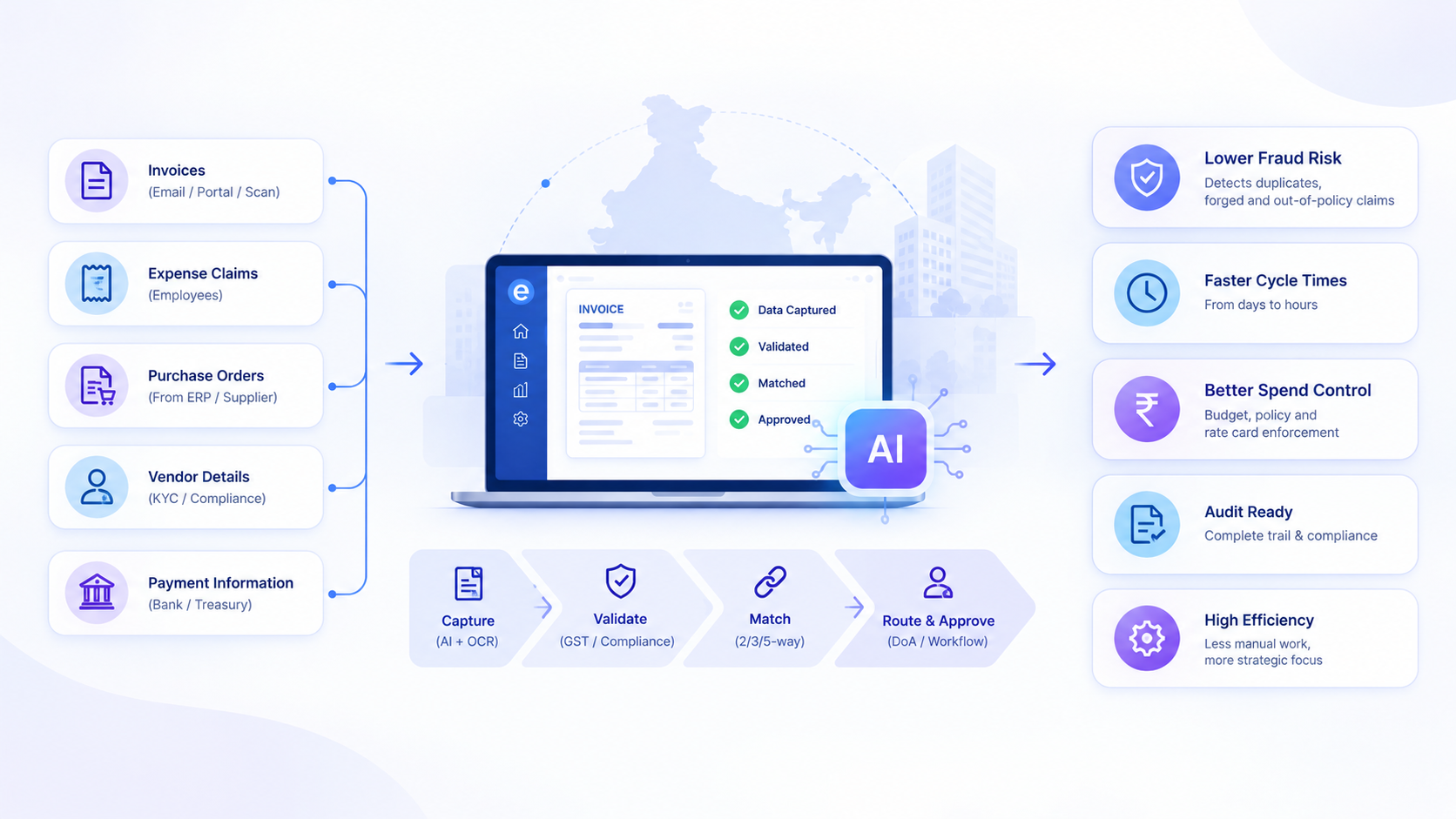
E-invoicing compliance in India is more than generating an IRN. It is about ensuring every B2B invoice meets GST standards, matches your records, and reconciles without ITC leakage. AI excels here because it handles the unstructured chaos of vendor invoices — PDFs, emails, images — and turns them into compliant, structured data. SSON reports that AI is expected to automate exception handling (32%) and streamline approvals.
Think about the daily grind: verifying vendor GST status, extracting HSN codes and tax breakdowns, checking for 30-day reporting deadlines, and ensuring 3-way matching (PO-GRN-invoice) aligns with e-invoice requirements. AI-powered intelligent document processing (IDP) does this automatically, reducing errors and freeing your team for higher-value work. As per a global survey by SSON, 43% see AI as most valuable for fraud prevention and intelligent invoice matching; 38% for data capture.
Another client, a growing services firm, faced TDS mismatches and late MSME payments alongside e-invoicing. Their old process led to manual chases and compliance risks. With AI, the AP system now auto-calculates TDS, categorizes vendors, validates IRNs against the IRP portal, and alerts on deadlines — turning potential fines into smooth operations.
Why CFOs need to lead this change
As a CFO, your focus is outcomes: protected cash flow, audit-ready books, and no surprises from the GST portal. AI makes e-invoicing compliance a strength, not a burden, by embedding validation into the workflow. It flags risks early — duplicate IRNs, invalid GSTINs, or unreconciled GSTR-2B entries — before they hit payments or audits.
In India’s ecosystem, where AP ties directly to GST, TDS, and MSME timelines, this visibility is gold. It helps you claim every rupee of ITC, avoid penalties starting at ₹50,000, and build supplier trust through reliable payments.
I have seen teams transform: what was a compliance headache becomes a dashboard of insights. One logistics client cut their reconciliation time by over 70% after AI integrated e-invoicing with their AP process, spotting anomalies that manual checks missed.
Making it practical
Do not overcomplicate it. Start with AI for invoice capture and IRN validation, then layer in GSTR-2B reconciliation and TDS automation. The best solutions are India-native: they understand GST nuances, handle multi-format invoices, and integrate with your ERP without custom coding.
My advice? Pilot it on your highest-volume vendors first. Measure ITC recovery, processing speed, and error rates. The results will speak for themselves.
The bigger opportunity
E-invoicing with AI is not just about survival; it is about turning AP into a strategic asset. It gives you real-time visibility into liabilities, optimizes working capital, and scales with your growth.
CFOs who embrace this now will lead their peers in compliance confidence and operational edge. In India’s fast-evolving regulatory landscape, that is the real competitive advantage. Let us build AP processes that are not only compliant, but intelligent.