A few months ago I sat across from an AP head at a mid-sized manufacturer. Midway through our demo she stopped me and said, “This is nice. But what happens when the invoice is in the vendor’s WhatsApp, the GRN is in the plant’s Excel, and the PO was raised by someone who has since left?”
That question is the real definition of AP automation in India. I’ve been having versions of that conversation for years, and the answer looks very different in 2026 than it did even two years ago.
Key takeaways:
- What it is: AP automation is software that runs the accounts payable cycle, from invoice capture to payment, with minimal manual effort.
- The India difference: It must validate GSTIN and IRN, check ITC eligibility, and track MSME deadlines under Section 43B(h) before payment, not after.
- Role of AI in 2026: AI-driven workflows read unfamiliar invoice formats and handle routine matching end to end, so finance teams focus on exceptions.
- Fraud control: Consistent matching, duplicate detection, and enforced approvals make fraud far harder to hide.
- Best fit: High-volume, high-compliance sectors like BFSI, NBFCs, insurance, and manufacturing.
What is AP automation?
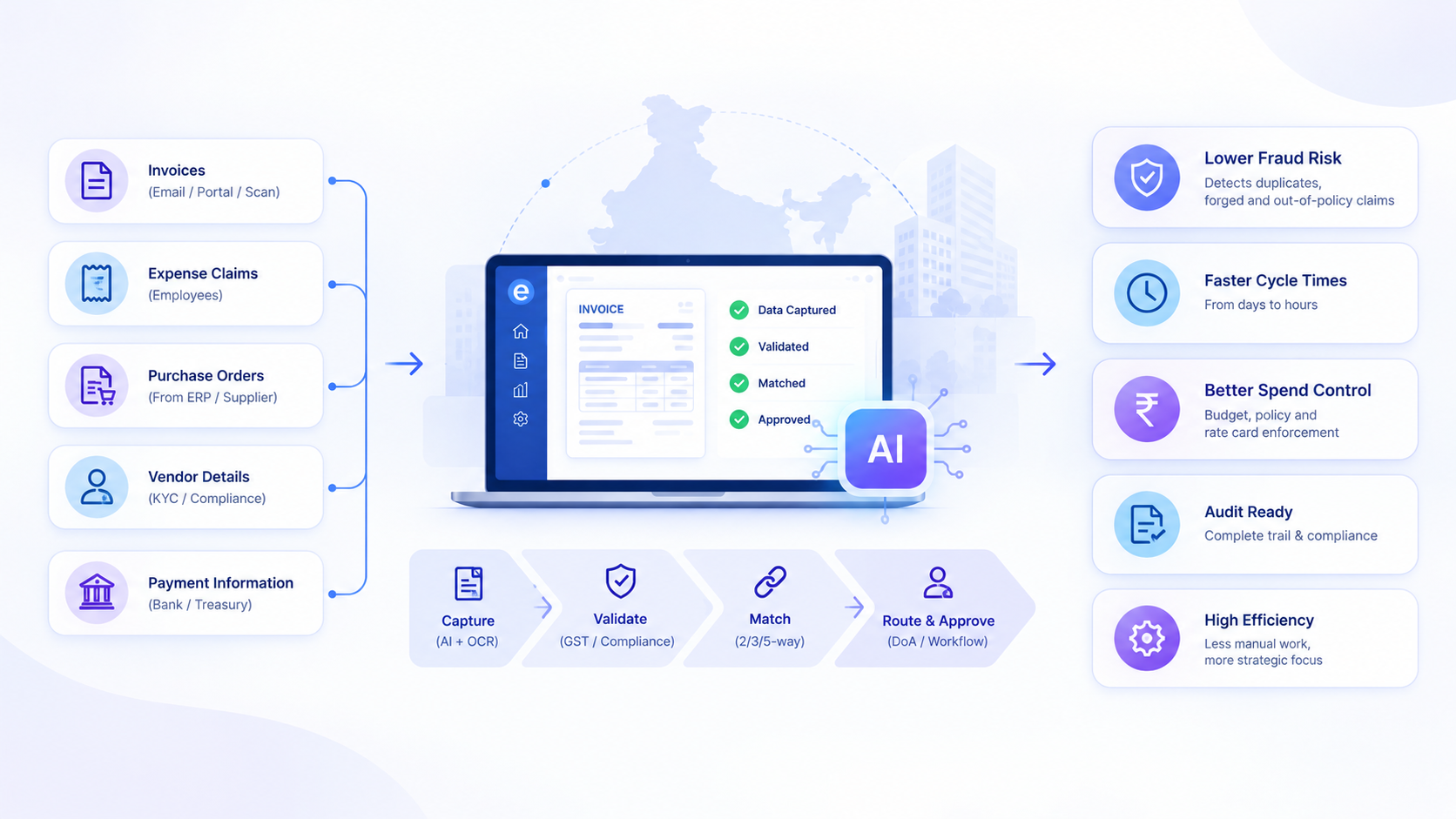
AP automation is software that handles the accounts payable cycle, from invoice capture to payment, with minimal manual touching. That covers reading the invoice, matching it against the purchase order and goods receipt, routing it for approval, checking it for compliance, and posting it to your ERP.
For Indian enterprises, that definition falls short. A global AP tool assumes a clean invoice and a simple tax layer. Ours arrive in a dozen formats, carry GST complexity, and sit inside approval hierarchies that reflect how Indian businesses actually run.
None of these problems are solved by writing a better Word document. They’re solved by a policy that’s encoded into the tools employees actually use to book and expense their travel.
Why is AP automation different in India?
The tax and compliance layer is the difference. Three things stand out.
- GST and ITC sit inside every invoice. Whether you can claim input tax credit depends on the vendor’s GSTIN being valid, the invoice appearing correctly in your GSTR-2B, and the vendor having filed. If your AP team finds a mismatch after payment, you have already paid for someone else’s compliance failure. Validation has to happen before the money moves.
- E-invoicing has changed what an invoice is. For businesses covered by the mandate, a valid invoice carries an IRN. An AP system that can’t read and verify that IRN is checking a document that may not be legitimate.
- MSME payment rules put a clock on your payables. Section 43B(h) ties the tax deduction on payments to micro and small enterprises to how quickly you pay them. Your AP process now has to know which vendors are MSME-registered and how many days are left, and it has to prioritise accordingly. A spreadsheet can’t do that at scale.
What does AP automation actually do, step by step?
A good system in 2026 does five things you’d otherwise do by hand:
- Captures invoices from anywhere. Email, vendor portals, scanned PDFs, and images all get read and structured without someone retyping fields.
- Validates compliance up front. It checks GSTIN, IRN, and ITC eligibility before the invoice enters the approval queue.
- Matches intelligently. Beyond the classic three-way match of PO, GRN, and invoice, we add checks against vendor GST data and contract terms. A mismatch is flagged for a person to review, so the whole batch doesn’t stall.
- Routes approvals through your Delegation of Authority. The invoice goes to the right approver based on value, category, and cost centre, with a full audit trail.
- Schedules payments strategically. It knows the due date, the MSME deadline, and any early-payment discount, and it recommends when to pay.
Where does AI fit in?
This is where 2026 is genuinely different. Earlier automation was rule-based, if the invoice looks like this, do that. Rules break the moment a vendor changes their format.
AI-driven, agentic workflows behave differently. They read an unfamiliar invoice, work out what it is, find the right PO even when the reference is messy, and decide whether to escalate. The system handles the routine cases end to end, and your team spends its time on exceptions and vendor relationships.
I’m cautious about how we talk about this in sales. AI does not replace judgement in finance. It removes the repetitive work that keeps good finance people from using theirs.
How does AP automation reduce fraud?
Manual AP is where duplicate invoices, fake vendors, and altered bank details slip through, mostly because a tired person is processing volume against a deadline. Automation applies the same checks to every invoice: duplicate detection, vendor validation, three- and five-way matching, and approval rules that can’t be bypassed on a busy Friday.
It won’t stop a determined internal fraud on its own. But it makes fraud visible, and most fraud depends on nobody looking closely.
Who should be looking at AP automation now?
You should be looking if any of these sound familiar:
- Your month-end close depends on chasing invoices and approvals.
- You’ve paid a vendor twice, or paid before a compliance issue surfaced.
- Your ITC reconciliation is a monthly scramble.
- You can’t say at any moment how much you owe and when it’s due.
- Your AP team has grown as fast as your invoice volume.
I’m most often talking to CFOs, AP heads, and finance controllers at BFSI, NBFC, manufacturing, and insurance companies. They run high-volume, high-compliance operations, and for them the cost of manual AP is large but hidden in the many small delays that add up.
What should you ask before choosing a solution?
Skip the feature checklist and ask these instead:
- Does it validate GST and IRN before approval, or only report on them later?
- Can it handle how your vendors actually send invoices?
- Does it fit your approval structure, or does it force you to rebuild it?
- What happens to an exception? Who sees it, and how fast?
- Does it integrate with your ERP without a long implementation?
If a vendor answers those clearly, you’re talking to someone who understands Indian finance.
The bottom line
AP automation in 2026 means an accounts payable function that is compliant by design, fast without cutting corners, and clear about where the money stands. It should feel less like software you operate and more like a team member who never misses a deadline.
If you’re weighing this for your enterprise, I’m always happy to talk it through, whether or not you end up working with us.
Frequently Asked Questions (FAQs)
What is AP automation?
AP automation is software that manages the accounts payable process from invoice capture to payment with minimal manual effort. It reads invoices, matches them to purchase orders and goods receipts, routes them for approval, checks compliance, and posts entries to your ERP.
How is AP automation different for Indian enterprises?
Indian AP has to handle GST, e-invoicing, and MSME payment rules that global tools weren’t built for. The system must validate GSTINs, verify IRNs, check ITC eligibility, and track vendor payment deadlines before payment, not after.
What is five-way matching?
Five-way matching extends the standard three-way match with two more checks. The extra layers catch errors and fraud that a basic match misses.
How does AP automation help with GST and ITC compliance?
It checks the vendor’s GSTIN and invoice details against GST data before the invoice is approved, so you find mismatches before payment. That protects your input tax credit and reduces the monthly reconciliation scramble.
What is Section 43B(h) and why does it matter for AP?
Section 43B(h) of the Income Tax Act allows a deduction for payments to micro and small enterprises only if you pay within the prescribed time, which is 45 days with a written agreement and 15 days without one. AP automation tracks vendor MSME status and due dates so payments are prioritised correctly.