
Blog

Is Manual Invoice Matching Enough Under GSTN’s New IMS(Invoice Management System)? Why Your ITC(Input Tax Credit) Says No

3 May 2026

Is Manual Invoice Matching Enough Under GSTN’s New IMS(Invoice Management System)? Why Your ITC(Input Tax Credit) Says No

Ila Imani - Founder CEO, Expenzing

One question keeps coming up in my discussions with CFOs and finance leaders: “How do we handle GSTN’s new Invoice Management System?” And almost always, my answer is: you’re asking only half the question. The real question is: can your AP process act on every invoice in real time, or is it quietly leaking Input Tax Credit every month without anyone noticing?

Because IMS isn’t a portal update you can read about and move on from. It changes who controls the clock on every vendor invoice, and for the first time, that clock is running on GSTN’s terms, not yours.


Here’s what’s different. Every invoice your supplier files in their GSTR-1 now lands directly in your IMS dashboard, sitting there until you accept it, reject it, or mark it pending. Only accepted invoices flow into your GSTR-2B and become eligible ITC. Do nothing, and GSTN’s default treatment takes over, on its timeline, not yours.

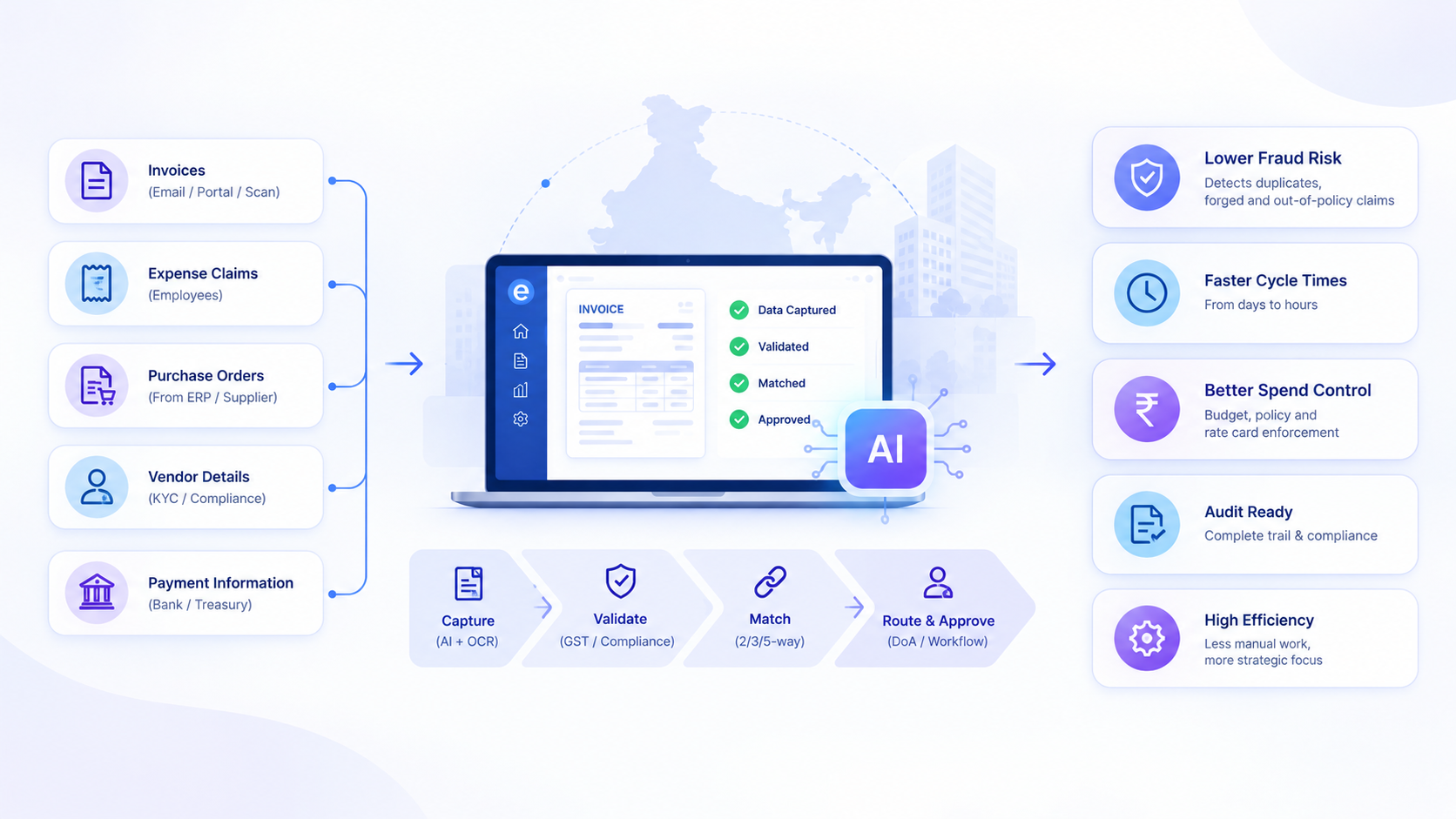
For a finance team reconciling a handful of vendor invoices a month, that might be manageable on a spreadsheet. For the BFSI, NBFC, manufacturing, and insurance enterprises we work with, processing thousands of vendor invoices monthly across multiple GSTINs, manual matching against POs, GRNs, and contract terms inside a compliance window measured in days is not a process gap. It’s a revenue leak waiting to happen.


When I talk to CFOs about what they need to act correctly on IMS at scale, the same requirements keep coming up:

• Continuous matching, not month-end matching. Every invoice needs to be checked against the PO, GRN, and contract the moment it appears in IMS, not reconciled in a batch three weeks later when the window has narrowed.

• Validation before acceptance, not after. Duplicate invoices, mismatched GSTINs, invoices from suppliers with a cancelled or non-compliant GST registration, these need to be caught before your team clicks “accept,” not discovered during an audit.

• Compliance checks baked into the decision. TDS applicability, MSME payment timelines, and tax head accuracy all factor into whether an invoice should be accepted, amended, or sent back, and that logic needs to run automatically, on every invoice, every time.

• A system that knows when to act and when to escalate. Routine, policy-compliant invoices should move through acceptance automatically. Anything that doesn’t match should be flagged and queued for review, not buried for someone to find later.


Wrongly accepted invoices mean blocked or reversed ITC. Wrongly rejected ones mean disputes with vendors who’ve already paid their output tax. Either way, the cost shows up later, in audit queries, in GST notices, in working capital tied up while corrections get sorted out.

That’s why the decision alone isn’t enough. Your team and your auditors need to see why an invoice was accepted, rejected, or kept pending, with the matching evidence attached. An AP system that logs that reasoning at the point of decision turns IMS from a compliance risk into a documented, defensible process.


No. Not anymore. GSTN built IMS to put the burden of real-time action on finance teams, and the teams that treat it as a connected, automated step in their AP process, rather than a new portal to check manually, are the ones who’ll protect their ITC instead of chasing it after the fact.

That’s the standard we hold Expenzing’s Accounts Payable Automation to: not just matching invoices, but protecting every rupee of credit you’re entitled to.

Read Our Blogs

28 May 2026

Cracking the Code on Section 43B(h): Sustaining MSME Payment Compliance Without Compromising Working Capital

Most tax liabilities announce themselves. GST notices, TDS defaults, and assessment queries are visible the moment they arise. Section 43B(h)

Shabbir Imani , Founder Director , Expenzing

AI That Understands Finance

29 Apr 2026

Is AI Enough? Why Finance Teams Need More Than Just AI

Every finance leader I speak to these days is asking some version of the same question: “Should we be using

Ila Imani - Founder CEO, Expenzing

blog feature image

6 Apr 2026

AI-Based Statutory Compliance Tracking

A Smarter Way to Stay Compliant The Continuous Nature of Compliance in India Statutory compliance in India is not periodic,

Satnam Kaur - Co-Founder and CTO, Expenzing

See the Possibilities. View our Demo.

satnam

Satnam Kaur

Co-Founder and CTO,
Expenzing

Satnam Kaur, Co-Founder and CTO of Expenzing, is a BITS Pilani alumna with deep expertise in information security, engineering management, and enterprise solution delivery. Beginning her career as a software developer and system analyst, she went on to lead product roadmaps, implementations, and large-scale technology teams. At Expenzing, Satnam heads technology, product development, and Infosec, playing a pivotal role in building secure, enterprise-grade SaaS solutions that balance innovation, precision, and client-centric delivery. A compassionate yet driven leader, she ensures that customer success remains central to every implementation, while also championing process excellence and automation. Beyond work, she enjoys travelling, singing, and contributing to social causes.

shabbir imani

Shabbir Imani

Founder Director,
Expenzing

Shabbir Imani, Co-Founder and Sales Director of Expenzing, holds a PGDM from IIM Calcutta (1985) with a specialization in Finance and Marketing. With over three decades of experience in enterprise solutions, he has a proven track record of scaling software products and driving business growth across industries. At Expenzing, Shabbir leads Sales and Strategy, shaping the company’s go-to-market approach and expanding its reach among large enterprises. A thought leader in spend management and a regular speaker at industry forums, he combines strategic vision with strong execution to deliver measurable business impact for clients, while also nurturing his personal passions for travel, music, and fitness.

illa imani

Ila Imani

Founder CEO,
Expenzing

Ila Imani, Founder CEO, and Product Owner of Expenzing, is an IIM Calcutta alumna (PGDM, 1986) with a specialization in Systems. She began her career as a systems analyst and programmer, gaining first-hand insights into the challenges of fragmented procurement and finance processes. Ila is the visionary behind Expenzing’s Spend Management Suite, guiding its evolution into a leading SaaS platform used by over 100 CFOs and hundreds of thousands of enterprise users. She drives the product roadmap with a strong focus on precision, compliance, and measurable client outcomes. Known for nurturing teams and building lasting client relationships, she drives the product roadmap with a focus on precision, compliance, and measurable outcomes, ensuring Expenzing consistently delivers value while redefining how enterprises control spend and manage compliance.

this for check box

Expenzing: Sourcing, Procurement and Accounts Payable Software
Privacy Overview

This website uses cookies so that we can provide you with the best user experience possible. Cookie information is stored in your browser and performs functions such as recognising you when you return to our website and helping our team to understand which sections of the website you find most interesting and useful.