Most finance teams in India don’t struggle with paying vendors. They struggle with paying the right vendor, the right amount, on the right day, with an invoice that will still hold up when the GST department asks about it two years later. That last part is what separates accounts payable automation in India from the same category anywhere else in the world, and it’s the part most generic tools quietly ignore.
Key takeaways
- Accounts payable automation in India has to be built around GST. Input tax credit depends on what your supplier reports, so every invoice needs to be validated before it is approved, not after it is paid.
- Invoice fraud detection works best as a set of checks at every stage: vendor onboarding, invoice capture, matching, approval and payment. Catching fraud only at the payment stage is too late.
- Statutory compliance goes beyond GST. TDS, MSME payment timelines and audit trail requirements all land on the AP team.
- Multi-location scale needs central policy with local approvals, across multiple GSTINs, entities and ERPs.
- Most implementation challenges come from data and people, not software: messy vendor masters, invoices in ten formats, and approvers who are used to email.
What is GST compliant accounts payable automation?
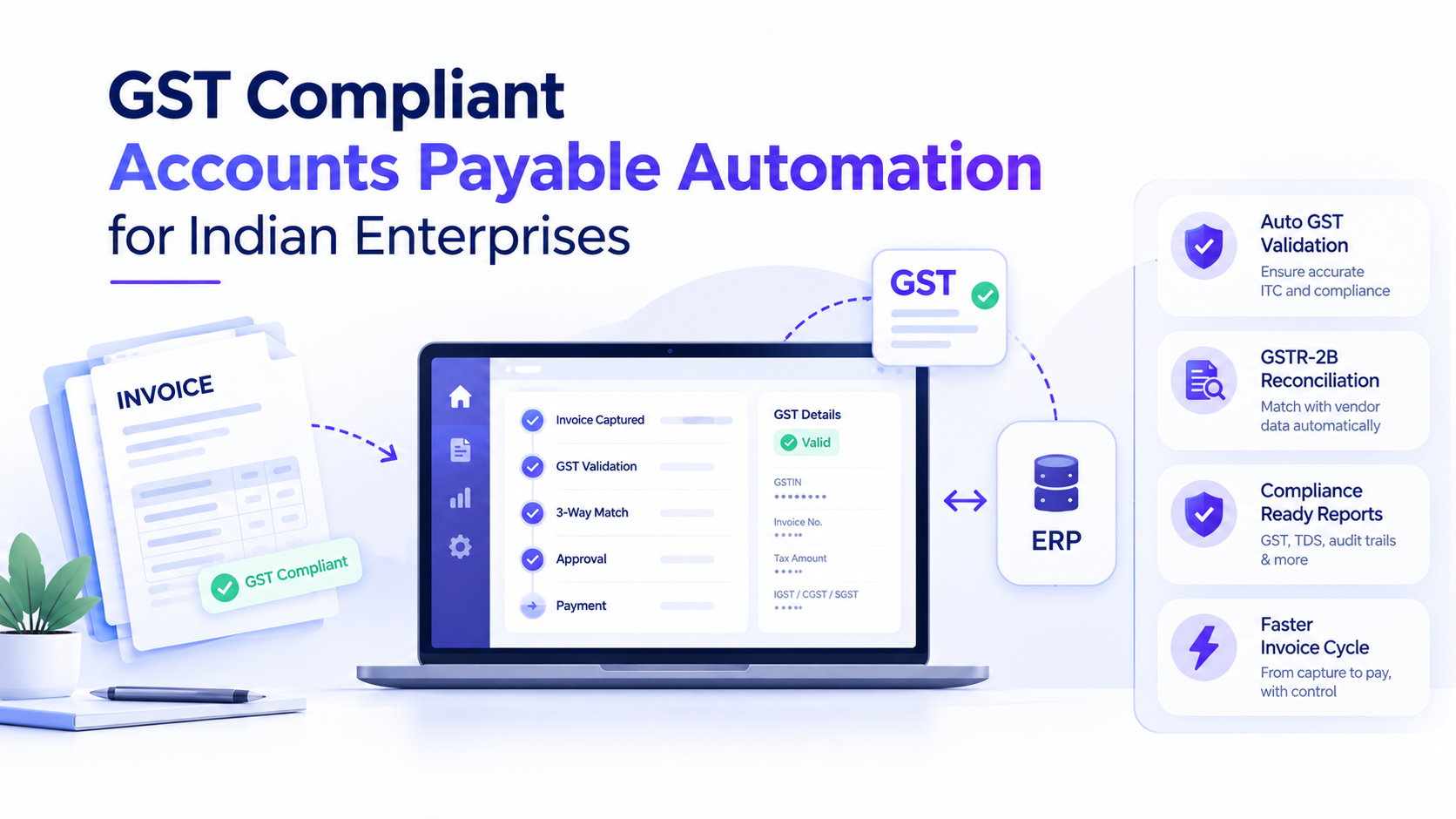
GST compliant accounts payable automation is software that captures vendor invoices, validates them against GST rules, routes them through approvals, matches them to purchase orders and receipts, and posts them to your ERP, while keeping a complete audit trail. The “GST compliant” part means the validation happens inside the workflow. The system checks GSTIN status, tax rates, place of supply and e-invoice details before an invoice reaches an approver, instead of leaving it to someone’s memory or a month-end clean-up.
I started Expenzing because I kept seeing capable finance teams spend their best hours on work a system should do: chasing missing details, re-keying invoices, and reconciling credit that should never have been in doubt.
Why does GST make accounts payable harder in India?
Because your tax position depends on your vendor’s behaviour. Under Section 16(2)(aa) of the CGST Act, you can claim input tax credit only when the invoice details your supplier has filed show up in your GSTR-2B. If a vendor files late, files wrong, or doesn’t file, the credit you were counting on becomes a problem that lands in your books.
A few other rules sit on top of that:
- Time limits. Section 16(4) puts a deadline on claiming credit for an invoice, and Rule 37 requires you to reverse credit if you haven’t paid the supplier within 180 days.
- MSME payments. Under Section 43B(h) of the Income Tax Act, payments to micro and small enterprises must be made within the statutory timeline (45 days at most, and 15 days where there is no written agreement) to claim the deduction in that year.
- E-invoicing. Businesses above the ₹5 crore aggregate turnover limit must generate e-invoices with an IRN. For businesses at ₹10 crore and above, the portal blocks reporting of invoices older than 30 days. If you are the buyer, that means a vendor’s invoice without a valid IRN is a risk you should see on day one.
These rules are easy to understand one at a time. The trouble is applying all of them, consistently, to thousands of invoices a month. That is a job for a system. Please confirm the current position with your tax advisor, as these rules are revised often.
How does invoice fraud detection work in AP automation?
Invoice fraud detection in AP automation works by running automated checks at each step an invoice passes through, so that a suspicious invoice is flagged before money moves. Fraud in AP is rarely dramatic. It usually looks like an ordinary invoice with one small thing wrong.
The checks that matter most:
- Duplicate detection. The same invoice submitted twice, or with a slightly changed number, date or amount.
- GST validation. Is the vendor’s GSTIN active? Does it match the name on the invoice? Is the tax charged correctly for the place of supply?
- Bank detail changes. A change to a vendor’s account number should trigger verification outside the invoice workflow, not a quiet update.
- Matching. Comparing the invoice with the purchase order, goods receipt and contract terms, and flagging anything that doesn’t line up.
- Delegation of Authority. Approval rules that follow your policy by amount, category and location, with no way to route around them. Splitting a large invoice into smaller ones to stay under an approval limit should be caught automatically.
- Audit trail. Every action recorded with who, what and when.
No single check is enough. Fraud tends to find the gap between two of them, which is why I’d rather see a mid-sized company run all of these consistently than a large one run a few of them well.
What does statutory compliance cover beyond GST?
It covers every legal obligation attached to paying a vendor. For an AP team in India, that typically means:
- TDS. Applying the right section and rate on vendor payments, deducting correctly and keeping the records needed for returns.
- MSME timelines. Tracking payment due dates by vendor classification, as covered above.
- Audit trail. The Companies (Accounts) Rules require accounting software used by companies to keep an edit log, and it can’t be switched off. Your AP process feeds directly into this.
- Documentation. Retaining invoices, approvals and supporting records in a form you can produce quickly for auditors and tax officers.
When these sit in spreadsheets and inboxes, compliance depends on individuals. When they sit in the workflow, compliance becomes the default way of working.
What makes AP software scalable across multiple locations?
Scalable enterprise solutions let you run one AP policy across many branches, plants and entities, without forcing every location to work the same way. In India this has a specific meaning. One PAN can have a GSTIN in every state you operate in, each with its own filing and credit position.
What I look for in a platform built for that reality:
- A single set of policies, with approval hierarchies that reflect how each location actually operates.
- Support for multiple GSTINs and legal entities, with reporting that rolls up cleanly for the CFO.
- Integration with the ERP you already run, so finance doesn’t maintain two sources of truth.
- The ability to add a new location or entity without a new implementation project.
The test is simple. Ask whether your tenth location will take as much effort as your first. If it will, the solution isn’t scalable.
What are the common implementation challenges?
The most common implementation challenges in AP automation are poor vendor data, invoice format variety, ERP integration and user adoption. I’d rather you hear this from me before you start than from your project team halfway through.
- Vendor master data. Duplicate vendors, missing GSTINs and outdated bank details will surface on day one. Clean the master before you automate, or use the rollout to do it.
- Invoice variety. Invoices arrive as PDFs, scans, email bodies and portal downloads, in different layouts. Your solution needs to read all of them reliably, and your team needs a clear path for the ones it can’t.
- ERP integration. Plan for it early. Posting, master data sync and payment status all depend on it.
- Approvers. The people who approve invoices are often outside finance, and they are busy. If approving takes longer than the old email chain, they will go back to the email chain. Mobile approvals and sensible defaults matter more than features.
- Exceptions. Every process has them. Decide who owns exceptions before go-live.
My advice is to start with one entity or location, prove it, and expand. A phased rollout is slower on paper and faster in practice.
How should a CFO evaluate India accounts payable software?
Start with these questions:
- Does it validate GST details at invoice capture, or only report on them later?
- Does it cover fraud checks across onboarding, matching, approval and payment?
- Can it handle TDS, MSME tracking and audit trail requirements natively?
- Does it work across multiple GSTINs, entities and ERPs?
- Who owns implementation, and what does the first 90 days look like?
A vendor who can answer these specifically, with India examples, understands your problem. One who answers in general terms probably doesn’t.
Where Expenzing fits
Expenzing Accounts Payable Automation is built for Indian enterprises, with GST validation, fraud controls, statutory compliance and multi-location control as part of the core workflow. If you’d like to see how it would work on your own invoices and approval structure, we’d be glad to show you.
Frequently Asked Questions (FAQs)
What is the best accounts payable automation for Indian Enterprises?
There is no single best product. The right choice is the platform that validates invoices against GST data, supports your authority matrix and integrates with your ERP at a price that holds as your volume grows.
Is accounts payable automation mandatory?
No. But e-invoicing and GST reconciliation have made manual processing risky and slow, and the cost of an error is now higher.
How long does implementation take?
It depends on your ERP, the number of entities and how clean your vendor master data is. Ask each vendor for a timeline based on your specifics and for the assumptions behind it.
Can AP automation reduce fraud?
Validation at entry, duplicate detection and enforced approvals reduce the openings for invoice fraud. They don’t replace sound internal controls.