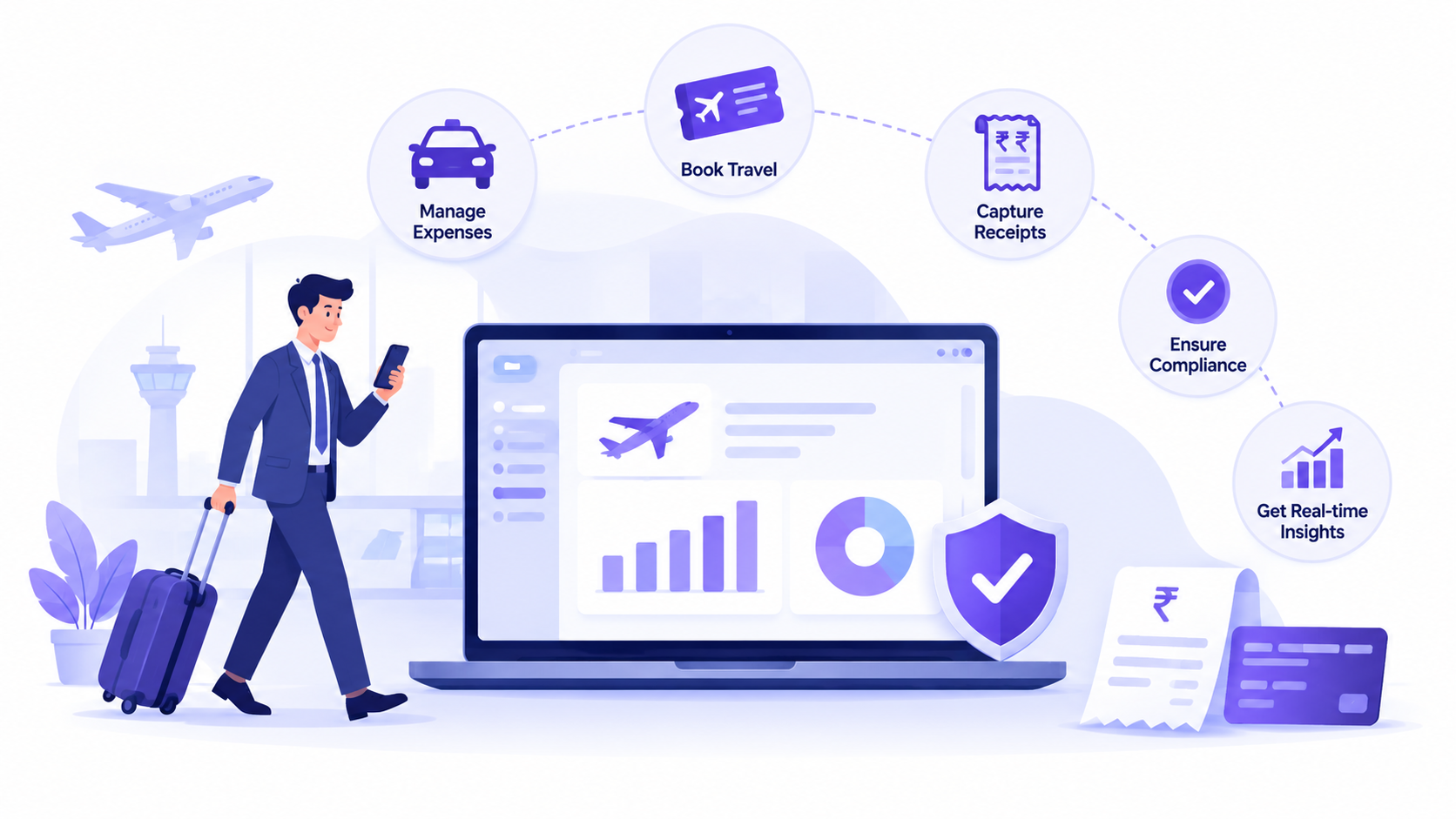
Ask a finance leader what their company spent on travel last quarter, and you will usually get an estimate, followed by “let me check with the team.” That pause is the real problem. Travel and expense management software exists to close it, so that spend is visible, governed and explainable while it happens, not weeks later.
Key takeaways
- Travel and expense management software (often shortened to TEM) connects travel booking, expense capture, policy checks and approvals in one system.
- Its main job is control before spend: policy is applied at the point of booking or claim, not discovered at month-end.
- Real-time visibility lets finance and procurement see committed spend, not just reimbursed spend.
- Automated approvals follow your authority matrix, so a claim reaches the right person without chasing.
- For enterprises, tax data capture, such as GSTIN on hotel and service invoices, is as important as the expense itself.
- Judge a platform by how well it enforces your policy and fits your ERP, not by how many features it lists.
What is travel and expense management software?
Travel and expense management software is a platform that manages how employees book business travel, spend company money and claim reimbursements, while enforcing company policy and giving finance a live view of the spend. It replaces the combination of emails, spreadsheets, paper receipts and approvals over chat that most organisations still run on.
I think of it as the layer between a company’s intent and its employees’ actions. Finance writes a policy: who can fly which class, what a city’s hotel cap is, which spends need a second approval. Without software, that policy lives in a PDF and depends on goodwill. With it, the policy is built into the workflow.
How does it differ from corporate travel management and corporate expense management?
The two terms describe halves of one problem.
-
Corporate travel management covers the planning and booking side: searching fares and hotels, getting approval before a trip, and keeping bookings inside negotiated rates.
-
Corporate expense management covers what happens after money is spent: capturing receipts, categorising spend, submitting claims, approving them and reimbursing.
Treated separately, they leave a gap. A booking made outside policy only surfaces later as an expense, when it can’t be changed. A combined TEM platform links the two, so the pre-trip approval, the booking and the final claim sit in one record.
How does it help control travel spend?
Travel spend is hard to control because it is spread across many people, small amounts and short time windows. Software helps in four ways.
- Policy enforcement at the source. The system checks a booking or claim against policy as it is made. Out-of-policy items are blocked, flagged or sent for justification, instead of being found in an audit.
- Visibility. Finance sees spend by employee, department, city, vendor and category, including approved trips that haven’t been billed yet. That is what makes travel spend control possible, because you can’t manage what you can’t see.
- Automated approvals. Requests route by your delegation of authority. Approvers act from a phone, delegates cover leave, and nothing sits unseen in an inbox.
- Cleaner data for negotiation. Procurement can see actual volumes by route and hotel, which is the starting point for any supplier negotiation.
What features should enterprise travel software have?
For enterprise and mid-market teams, I would look for:
- Configurable policy engine. Rules by grade, department, geography and trip type, editable by finance without a developer.
- Pre-trip approval. The request is approved before money is committed.
- Mobile receipt capture. Employees photograph a bill and the system reads it, so expense tracking takes minutes, not an evening.
- Corporate card and payment reconciliation. Card transactions matched to claims and bookings.
- Tax-aware capture. Supplier GSTIN and tax details extracted so credit can be claimed correctly where eligible. Confirm the treatment with your tax advisor.
- ERP and accounting integration. Approved expenses posted to the ledger without re-keying.
- Audit trail and reporting. Who approved what, when and under which policy.
- Duplicate and fraud checks. Catching the same receipt claimed twice, or a claim that doesn’t fit the pattern.
Who in the company benefits?
- Finance gets faster closes, fewer reconciliation surprises and a defensible audit trail.
- Procurement gets spend data to negotiate with and a way to steer bookings towards preferred suppliers.
- Employees stop fronting money and waiting weeks for reimbursement, and they know the rules before they spend.
- Leadership gets one view of what the organisation spends on moving people around, and whether it is worth it.
How do you know when you need it?
A few signs tell you the manual approach has run out of road:
- Month-end close waits on expense claims.
- You can’t answer “what did we spend on travel in this region” without a data pull.
- Policy exceptions are common and nobody can say how common.
- Employees pay out of pocket and are reimbursed late.
- Auditors ask for approval evidence and it takes days to assemble.
If two or more of these sound familiar, the cost isn’t only the spend. It is the finance team’s time spent reconstructing what software would have recorded.
Frequently Asked Questions (FAQs)
What does TEM stand for?
TEM stands for travel and expense management. Some teams use it to mean the software, others the discipline of managing these costs.
Is travel and expense management software only for large enterprises?
No. Mid-market companies often feel the pain earlier, because their volumes have outgrown spreadsheets while their finance teams are still small.
Does it replace a travel agent?
Not necessarily. Some platforms include booking, others integrate with existing agents or booking channels. The key requirement is that bookings flow into the same policy and expense record.
How is it different from general AP automation?
Accounts payable handles vendor invoices. TEM handles employee-driven spend: bookings, claims and card transactions. Many enterprises want both to share one view of spend.