
One question keeps coming up in my discussions with CFOs and finance leaders: “How do we handle GSTN’s new Invoice Management System?” And almost always, my answer is: you’re asking only half the question. The real question is: can your AP process act on every invoice in real time, or is it quietly leaking Input Tax Credit every month without anyone noticing?
Because IMS isn’t a portal update you can read about and move on from. It changes who controls the clock on every vendor invoice, and for the first time, that clock is running on GSTN’s terms, not yours.
IMS Has Changed the Rules of Reconciliation
Here’s what’s different. Every invoice your supplier files in their GSTR-1 now lands directly in your IMS dashboard, sitting there until you accept it, reject it, or mark it pending. Only accepted invoices flow into your GSTR-2B and become eligible ITC. Do nothing, and GSTN’s default treatment takes over, on its timeline, not yours.
For a finance team reconciling a handful of vendor invoices a month, that might be manageable on a spreadsheet. For the BFSI, NBFC, manufacturing, and insurance enterprises we work with, processing thousands of vendor invoices monthly across multiple GSTINs, manual matching against POs, GRNs, and contract terms inside a compliance window measured in days is not a process gap. It’s a revenue leak waiting to happen.
What Real-Time IMS Handling Actually Requires
When I talk to CFOs about what they need to act correctly on IMS at scale, the same requirements keep coming up:
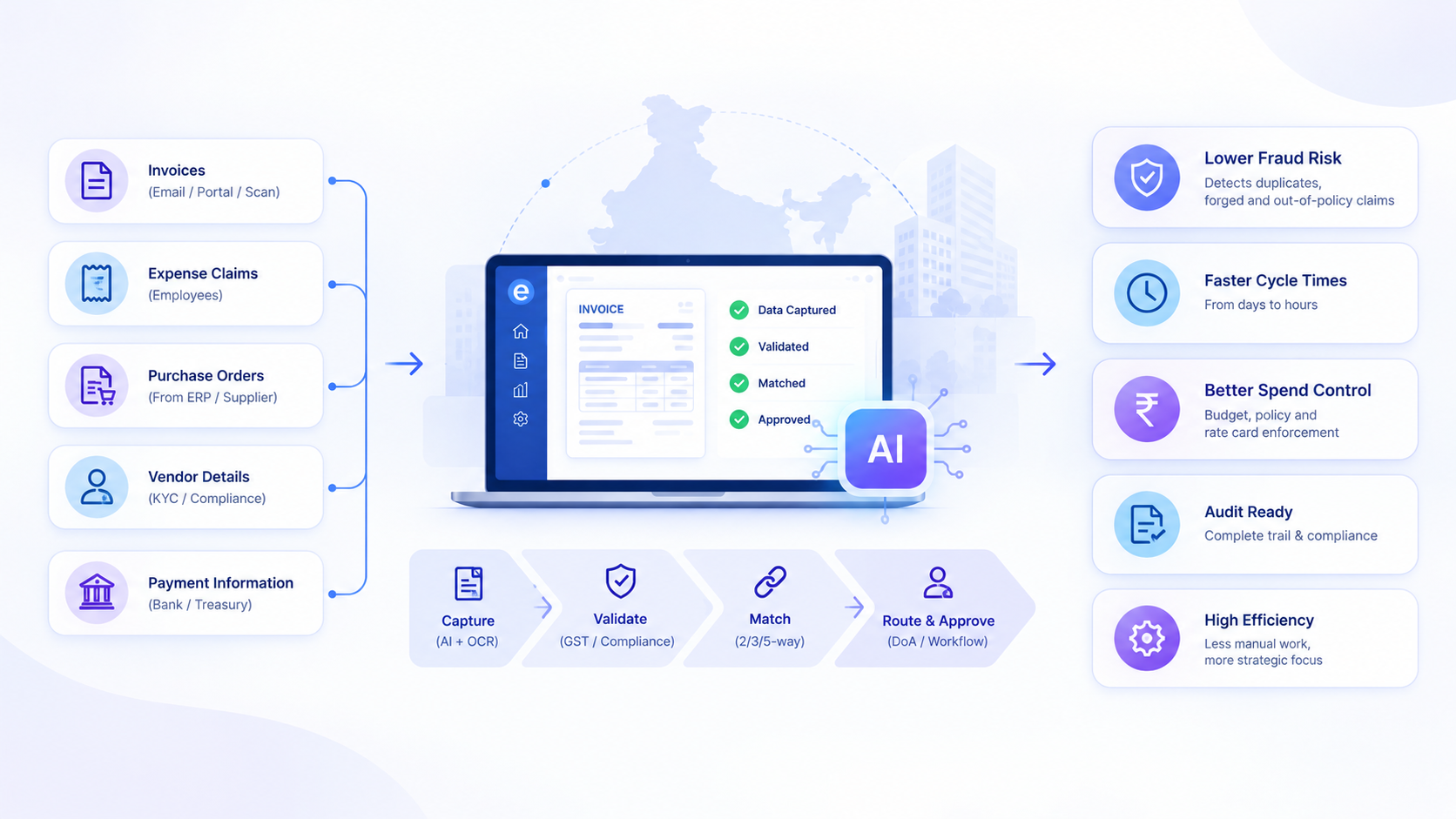
• Continuous matching, not month-end matching. Every invoice needs to be checked against the PO, GRN, and contract the moment it appears in IMS, not reconciled in a batch three weeks later when the window has narrowed.
• Validation before acceptance, not after. Duplicate invoices, mismatched GSTINs, invoices from suppliers with a cancelled or non-compliant GST registration, these need to be caught before your team clicks “accept,” not discovered during an audit.
• Compliance checks baked into the decision. TDS applicability, MSME payment timelines, and tax head accuracy all factor into whether an invoice should be accepted, amended, or sent back, and that logic needs to run automatically, on every invoice, every time.
• A system that knows when to act and when to escalate. Routine, policy-compliant invoices should move through acceptance automatically. Anything that doesn’t match should be flagged and queued for review, not buried for someone to find later.
ITC at Stake: Why the Audit Trail Matters as Much as the Decision
Wrongly accepted invoices mean blocked or reversed ITC. Wrongly rejected ones mean disputes with vendors who’ve already paid their output tax. Either way, the cost shows up later, in audit queries, in GST notices, in working capital tied up while corrections get sorted out.
That’s why the decision alone isn’t enough. Your team and your auditors need to see why an invoice was accepted, rejected, or kept pending, with the matching evidence attached. An AP system that logs that reasoning at the point of decision turns IMS from a compliance risk into a documented, defensible process.
So, Is Manual Matching Enough?
No. Not anymore. GSTN built IMS to put the burden of real-time action on finance teams, and the teams that treat it as a connected, automated step in their AP process, rather than a new portal to check manually, are the ones who’ll protect their ITC instead of chasing it after the fact.
That’s the standard we hold Expenzing’s Accounts Payable Automation to: not just matching invoices, but protecting every rupee of credit you’re entitled to.